
Most people come to Costa Rica for a week or two. But sometimes life only gives you 48 hours — a long layover stretched into a weekend, a business trip with a free Saturday, a cruise port day that turns into an overnight.
The good news: Costa Rica is one of the few countries in the world where two days is actually enough to see something real. The capital sits in the middle of the country, an active volcano is 90 minutes away, a proper rainforest is an hour in the other direction, and some of the best food on the isthmus is waiting a few blocks from your hotel. What you need is a plan that doesn’t waste a single hour. Here’s one that works.
Before You Land
The one decision that matters
Pick your base before you pick anything else. With only 48 hours, you don’t have time to shuttle between regions. The two bases that actually work for a two-day window:
Option A
Central Valley
Best for variety: volcanoes, coffee country, cloud forest day trips, and the country’s best restaurant scene. You’ll land here anyway at SJO.
Option B
La Fortuna / Arenal
Best for immersion: a volcano out your window, hot springs after dark, rainforest in the morning. Three-hour drive from SJO eats into Day 1.
This itinerary uses the Central Valley base. It’s the version that gives you the most to see in the least driving — what most short-stay travelers will want their first time in the country.
Day One
Volcanoes, coffee, and your first real Tico meal
A crater, a waterfall, and the neighborhood that changed San José’s food scene.
Morning
Poás or Irazú Volcano
Get there early. This is not optional advice. By mid-morning the clouds roll in and the crater you drove an hour to see disappears behind a white wall. Aim to be at the gate when the park opens.
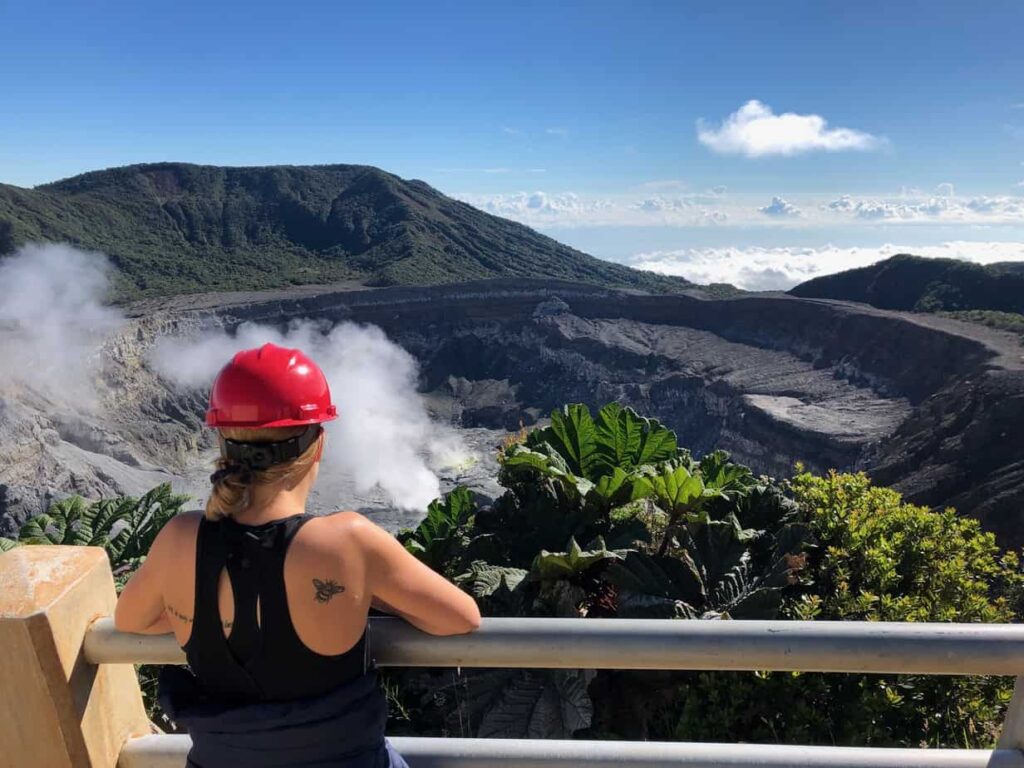
Poás is the easier choice from San José or Alajuela — about 90 minutes up through coffee farms and strawberry fields, and the payoff is a turquoise acid lake sitting inside one of the largest active craters in the world. The viewpoint is a short, paved walk from the parking lot, so it works even if you landed late the night before.
Irazú is the alternative — higher, starker, moon-like. On a clear day you can technically see both oceans from the summit. You rarely get a clear day, but the drive up through Cartago and the sheer scale of the crater make it worth the trip.
Midday
La Paz Waterfall Gardens or a coffee tour
On the way back down from Poás, two natural stops compete for your afternoon:
- La Paz Waterfall Gardens — five waterfalls, an animal sanctuary with rescued toucans, sloths, and jaguars, and a buffet lunch included in the entry ticket. Touristy, yes, but genuinely well done and easy on travelers still adjusting to altitude and jet lag.
- Doka Estate or Espíritu Santo coffee tour — you’re driving through the country’s best coffee-growing region, and a two-hour tour walks you from the bean on the branch to the cup in your hand. If you care at all about coffee, do this instead.
Evening
Dinner in Barrio Escalante
Head back into the capital and get yourself to Barrio Escalante, the neighborhood the San José food scene has quietly concentrated itself in. Calle 33 is the main artery — a few blocks of restaurants, cocktail bars, and bakeries that have nothing to do with the tourist-trap vibe many first-timers expect from the capital.
For a first dinner in the country, look for a place doing cocina tica moderna — contemporary takes on Costa Rican staples like olla de carne, chifrijo, or fresh ceviche. Skip the hotel restaurant. This is the one night you’ll actually be in the city.
Day Two
Cloud forest, hanging bridges, and a long lunch
The rainforest experience without the four-hour drive to Monteverde.
Morning
The cloud forest, closer than you think
Monteverde is the famous cloud forest, but it’s four-plus hours each way from San José — impossible on a two-day trip. The workaround is the Braulio Carrillo National Park corridor, about an hour northeast of the capital on the road toward the Caribbean. Same primary rainforest, same mist, same chance of spotting a quetzal or a sloth, without the driving penalty.
Inside this corridor, two operations are worth your morning:
- Rainforest Adventures (Aerial Tram) — a guided gondola through the canopy, paired with walking trails and optional zip-line add-ons. Good for travelers who want the experience without a strenuous hike.
- Tirimbina Biological Reserve — a longer suspension bridge over the Sarapiquí River, self-guided trails, and one of the best chocolate tours in the country. Less polished than the tram, more real.
Midday
Lunch at a classic soda
Your last full meal in the country should be at a soda — the Costa Rican version of a diner, where a casado (rice, beans, plantains, salad, and a protein) costs a fraction of what the tourist restaurants charge and tastes twice as good. Ask the desk clerk at your hotel, or the guide on your morning tour, where they actually eat. That’s the soda you want.
Order the casado con pollo en salsa, a glass of fresco natural — fresh fruit juice, try cas or tamarindo — and plan to linger.
Afternoon
One last choice before the airport
Depending on your flight time, close out the trip with one of these:
Pre-Columbian Gold Museum
Mercado Central
Thermal springs day pass
Craft shopping in Escazú
Sabana Park walk
- The Jade or Gold Museum — both compact, both genuinely good, both a better use of a rainy afternoon than most travelers expect.
- The Central Market — a century-old labyrinth of stalls selling spices, leather, hammocks, and souvenirs worth actually bringing home. Not manicured, which is the point.
- A thermal-spring afternoon — if you skipped Arenal for proximity, a handful of hot-spring resorts in the Central Valley foothills offer day passes. Less dramatic than Tabacón, but you’ll still be soaking in volcano-heated water a few hours before your flight.
Practical Notes
What nobody tells you about a 48-hour trip
Rent a car — or don’t
For this itinerary, a rental car gives you the most flexibility and the best shot at early-morning crater views. But Costa Rica’s roads are narrower, slower, and less signposted than most visitors expect, and night driving is strongly discouraged. If navigating from scratch stresses you out on a short trip, a private driver for Day 1 is worth the money — expect it to cost roughly the same as a rental car plus gas once you factor in the airport transfer and volcano parking.
What to pack for 48 hours
The Central Valley sits at altitude, which means cool mornings (long sleeves at the volcano — genuinely), warm middays, and the chance of rain basically any afternoon.
Long-sleeve layer
Trail shoes
Sandals
Reef-safe sunscreen
Small daypack
Money
US dollars are accepted almost everywhere that deals with tourists, but you’ll get better value paying in colones at sodas, markets, and small shops. Cards work at anything tourist-facing; keep a small amount of cash for parking, tips, and the places where the card reader is inevitably “down today.”
The Verdict
Can you really see Costa Rica in two days?
You cannot see Costa Rica in 48 hours. Anyone who tells you otherwise is selling something. What you can do — and what this itinerary is built for — is get a legitimate taste: an active volcano, a rainforest, a proper Tico meal, and enough of a sense of the country that you’ll know exactly where to go when you come back.
And you will come back. Almost everyone does.
¡Pura vida!