
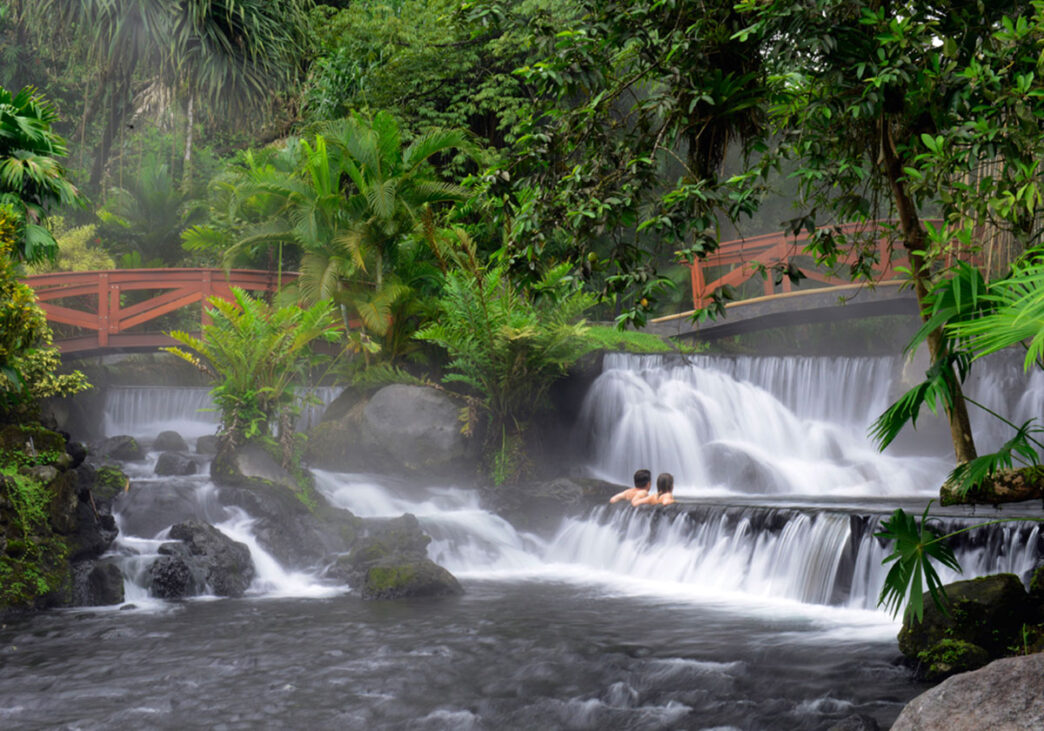

Costa Rica’s hot springs are one of its easiest wins — warm, mineral-rich water heated by a live volcano, waiting at the end of a hard day of hiking. But most first-timers picture a wild natural pool in the jungle, then arrive to find a $110 resort with a swim-up bar. Here’s how the real options compare, from free rivers to luxury spas, and how to pick the one that fits your trip.
Start Here
What Costa Rica’s hot springs actually are
Nearly every hot spring worth visiting in Costa Rica sits at the base of an active or recently active volcano. Groundwater seeps down toward the magma, gets superheated, picks up minerals like calcium, magnesium, and silica, and rises back to the surface. The undisputed capital of this is La Fortuna, the town at the foot of Arenal Volcano in the northern lowlands — a two-and-a-half-hour drive from San José (SJO) or about 90 minutes from Liberia (LIR).
Here is the part nobody tells you: with one exception, the famous “hot springs” you’ve seen in photos are not natural pools you stumble upon. They’re resorts. The thermal water is real and naturally heated, but it’s channeled into landscaped, man-made pools with tiled bottoms, bars, and gift shops. That’s not a knock — some are genuinely beautiful — but it changes how you should plan and budget.
Clear The Air
Three things travelers get wrong about hot springs here
Almost all of them are commercial resorts with constructed pools. The water is naturally heated, but you’re paying for a landscaped facility, not a secret jungle spring. The only true wild soak — a genuine free-flowing hot river — is El Choyín (more on that below). If a “natural” experience is the whole point of your trip, plan for that one specifically instead of assuming every option delivers it.
Prices run from completely free at the public hot river to around $125 for a top-tier resort day pass with meals. Budget options like Termalitas del Arenal and mid-range picks like Paradise Hot Springs land well under the headline resort prices. The eye-watering figures you see quoted online are usually the all-in packages with lunch, dinner, and a massage bundled in.
Arenal has the most and the fanciest, so it dominates search results — but it’s not the only place. Rincón de la Vieja in Guanacaste has thermal pools and mud baths in a very different, drier landscape, and the Orosi Valley southeast of San José has low-key spa pools. If you’re not routing through the northern lowlands, you still have options.
The Main Event
Arenal hot springs, compared
This is where most travelers will end up, so here’s the honest rundown. Prices below are typical adult day-pass ranges and shift with season, meal add-ons, and holidays — always confirm on the official site before you go, and remember most quotes are before the 13% tax.
| Hot spring | Vibe | Adult day pass (approx.) | Best for |
|---|---|---|---|
| Tabacón | The icon — a natural thermal river winding through manicured gardens; no visible pipes or tiled edges. Read our full review | $90–125 (with meal) | Special occasions, couples, the “wow” photo |
| The Springs Resort | Best volcano views, world-class spa, many pools on a hillside | $75–110 | Views and spa amenities |
| Baldi | 25 pools, waterslides, swim-up bars — the loud, fun, big one | $40–99 (entry vs. meals) | Families, groups, kids who need slides |
| EcoTermales | Intimate, capped daily capacity, lush and quiet; reservations required | $49–65 | Peace and a natural feel without going wild |
| Paradise Hot Springs | Smaller, calm, affordable; a big central pool and quiet nooks | ~$47 | Value seekers, couples, older families |
| Titoku | Newer, adults-oriented, sleek and mellow | ~$45–60 | A quieter, modern soak |
| Termalitas del Arenal | No-frills local favorite, cheapest paid option | Budget (lowest tier) | Tight budgets, families, weekday soaks |
Most resorts offer a daytime and an evening window. Soaking after dark — steam rising, jungle sounds, the volcano’s silhouette — is the better experience, and it pairs perfectly with a day of hiking or the La Fortuna Waterfall. Reserve ahead in dry season (December–April); the popular resorts hit capacity.
The Free One
El Choyín: the only truly wild (and free) hot springs
If you want the natural experience the brochures imply, this is it. El Choyín — also spelled Río Chollín, and nicknamed “little Tabacón” — is a public section of the same thermal river that feeds Tabacón. It flows off the resort’s property into a stretch that’s free and open to anyone, 24 hours a day. You soak in a real hot river over smooth rocks, forest all around, no tiled pool in sight. Water runs roughly 80–105°F depending on where you sit.
It’s about 12 km (a 15–20 minute drive) from La Fortuna on Route 142 toward the volcano, just past the Tabacón entrance. There’s a short path down to the water. Note that a managed paid section called Choyín Royal Thermal has opened across the road with parking, lockers, and food for around $25 — a middle-ground option if the free stretch feels too rough.
Men in orange or yellow vests near the free section will approach you demanding a parking fee (often around ¢5,000, roughly $10). They are not official guards. Pay in colones if you must, never dollars, or park farther up the road and walk down. Petty theft is common here — don’t leave valuables in the car or unattended on the bank. Go early (before 8 a.m.) for a quiet, safer soak and no crowds.
Beyond Arenal
Hot springs outside La Fortuna
Rincón de la Vieja, Guanacaste
In the dry northwest, this volcano region offers thermal pools and volcanic mud baths at private operations near the national park, plus natural springs in the Las Pailas sector. The setting is dry tropical forest rather than rainforest, and it pairs well with a Guanacaste beach trip — a good pick if you’re flying into Liberia and skipping the northern lowlands entirely.
Orosi Valley, near Cartago
Southeast of San José, the Orosi Valley has modest thermal pools that see far fewer tourists. They’re not dramatic, but if you’re based in the Central Valley and just want a warm soak without the drive to Arenal, they do the job.
Match Yourself
Which hot spring should you pick?
Best views: The Springs
Kids & fun: Baldi
Quiet & natural feel: EcoTermales
Best value: Paradise
Free & wild: El Choyín
Guanacaste base: Rincón de la Vieja
A swimsuit worn under your clothes, cheap flip-flops or water shoes (rocks and wet tile are slippery), a small quick-dry towel, and a waterproof bag or dry pouch. Most resorts rent lockers and towels for a few dollars. Skip jewelry and leave your passport at the hotel safe. Reef-safe sunscreen only if you’ll be in daylight pools.
FAQ
Costa Rica hot springs: quick answers
Are Costa Rica’s hot springs natural?
The water is naturally heated by volcanic activity, yes. But at almost every resort it’s channeled into man-made pools. The one genuinely natural, free-flowing option near La Fortuna is the El Choyín (Río Chollín) hot river.
How much does a hot springs day pass cost?
Anywhere from free (El Choyín) to about $125 for a premium resort pass with meals. Mid-range resorts run roughly $45–75. Most posted prices don’t include the 13% sales tax.
Which is the best hot spring in La Fortuna?
There’s no single winner — it depends on your priorities. Tabacón for the wow factor, The Springs for views, Baldi for families, EcoTermales for quiet, Paradise for value.
Do I need to book in advance?
In dry season (December–April) and around holidays, yes — the popular resorts sell out and EcoTermales caps daily visitors year-round. In green season you can often walk up, but booking still guarantees your slot.
Are the hot springs safe for kids?
Generally yes. Baldi is the most kid-friendly with slides and varied pool temperatures. At El Choyín, stick to shallow, slower sections and hold small children — it’s a natural river with rocks and current.
Can I visit hot springs on a day trip from San José?
It’s a long day — roughly 2.5 hours each way to Arenal. Doable, but you’ll spend more time driving than soaking. Most travelers stay at least one night in La Fortuna — see our guide to the best hotels in Arenal, several of which have their own thermal pools.
What should I not do at the hot springs?
Don’t over-soak (20–30 minutes at a time in the hottest pools), don’t drink heavily in the heat, and don’t leave belongings unattended — especially at the free river. Stay hydrated with water, not just cocktails.