
Costa Rica volcano alert levels come from two different systems. OVSICORI, the national volcano observatory, rates each volcano’s activity on a four-level scale: 1 green (normal), 2 yellow (warning), 3 orange (caution) and 4 red, the highest level. Separately, the CNE, the national emergency commission, declares green, yellow, orange or red emergency alerts for specific areas, such as a national park or nearby towns. Park access is decided by the park authorities and can change within hours, so check official sources before any volcano visit instead of relying on any article, including this one.
Costa Rica sits on the Pacific Ring of Fire and has five volcanoes generally considered active: Poás, Turrialba, Irazú, Rincón de la Vieja and Arenal. This guide explains what each alert color means, why the two systems can show different colors at the same time, and how to check the current status in a couple of minutes. For an overview of the volcanoes themselves, see our guide to Costa Rica’s volcanoes.
| OVSICORI activity level | CNE emergency alert | |
|---|---|---|
| What it measures | What the volcano is doing (quakes, gas, eruptions) | What emergency agencies and towns need to do |
| Who sets it | OVSICORI-UNA scientists | The CNE, with advice from scientists |
| Scale | Level 1 green to Level 4 red | Green, yellow, orange, red |
| Applies to | The volcano | Specific areas: the park, nearby cantons |
| Does it close the park? | Not by itself | Not by itself; park authorities decide access |
Who Issues the Alerts?
OVSICORI-UNA (Observatorio Vulcanológico y Sismológico de Costa Rica, at the Universidad Nacional) is the country’s main scientific monitoring body. Its volcanologists, seismologists and chemists track earthquakes, gas emissions, ground deformation and eruptions around the clock, and they set each volcano’s activity level.
The CNE (Comisión Nacional de Prevención de Riesgos y Atención de Emergencias) is the national emergency commission. Using reports from a technical committee that includes OVSICORI, it declares emergency alerts for specific areas and coordinates local governments, SINAC (the national parks authority), health officials and emergency services. SINAC and the park administration decide if a volcano park opens, closes or limits visitors.
The Four-Level Alert Scale
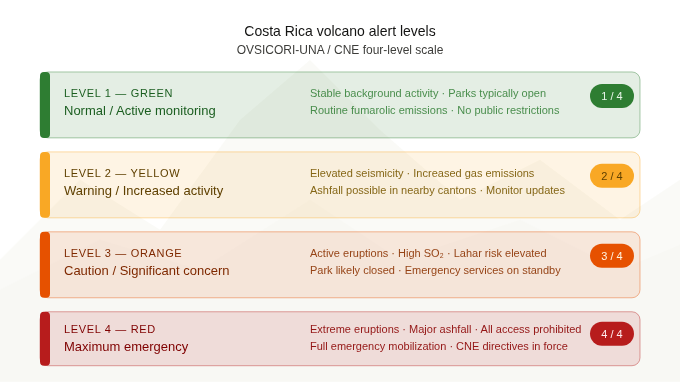
OVSICORI’s scale runs from Level 1 to Level 4, color-coded green, yellow, orange and red. The CNE uses the same four colors for its emergency alerts, but its colors don’t always match the OVSICORI level. A CNE green alert, for example, is a preventive declaration that tells agencies to stay ready; it’s often issued when a volcano is more active than usual and doesn’t by itself close a park.
Level 1 Green — Normal / Active Monitoring
A Level 1 volcano is in its baseline state. There may be low-level activity, such as steam, small tremors or a whiff of sulfur, but nothing beyond its normal pattern. Scientists keep monitoring, as they always do.
What You Might See
- Routine steam or gas plumes at the crater
- Background seismicity within normal ranges
- No notable changes in ground deformation
What It Means for You
- Volcano parks are usually open, with standard park rules
- Stay on marked trails and out of closed areas
Most of Costa Rica’s volcanoes spend most of their time at Level 1. Arenal, for example, has been quiet since its long eruptive period ended around 2010. See our La Fortuna and Arenal guide.
Level 2 Yellow — Warning / Increased Activity
Yellow means OVSICORI has detected activity above the normal baseline: more frequent or stronger earthquake swarms, more gas, a hotter crater lake or early signs that the ground is swelling. Small eruptions can happen at this level.
What Scientists Are Seeing
- Minor eruptions or strong bubbling in crater lakes
- Increased emissions of acid gases (SO₂, H₂S)
- Seismic swarms or elevated tremor levels
- Slight inflation of the volcano
What It Means for You
- The park may stay open with limits, such as fewer visitors, shorter visits or closed viewpoints
- Nearby towns may notice gas odors or light ash
- Follow ranger instructions and check the park’s announcements on the day of your visit
Level 3 Orange — Caution / Significant Concern
Orange means significant unrest: frequent eruptions, ash columns, high gas output and, in some cases, signs that magma is rising. Access restrictions are likely, and emergency agencies step up their preparations.
Indicators at This Level
- Eruptions with ash plumes, often hundreds of meters to more than a kilometer high
- High sulfur dioxide emissions
- Elevated seismicity
- Possible ejection of hot rocks near the crater
- Higher risk of lahars (volcanic mudflows) along rivers that drain the volcano
What Authorities Do
- The national park is often closed or limited to a safe area
- The CNE may raise alerts for the park and nearby cantons
- Health officials prepare for respiratory complaints in nearby towns
Poás spent much of 2025 at Level 3, and its national park stayed closed for several months that year before reopening.
Level 4 Red — Highest Level
Red is the highest level. The volcano is producing major activity that poses direct danger at the crater and possibly to nearby communities through ashfall, gas and lahars. The park is closed, and emergency services follow CNE orders for the affected areas.
Conditions at Red Alert
- Large eruptions with ash columns reaching kilometers high
- Significant ashfall across several cantons
- High probability of lahars along rivers
- Possible flight disruptions
What to Do
- Stay out of the park and any restricted zone
- Follow CNE evacuation or shelter-in-place instructions
- Stay indoors with windows closed if ash or gas reaches your area, and wear an N95 mask outside
- Keep away from rivers that drain the volcano
- Get updates from official channels only
On April 23, 2025, after strong eruptions at Poás, the CNE declared a red alert for Poás Volcano National Park, an orange alert for the cantons of Grecia and Sarchí, and a yellow alert for Alajuela, Poás, Naranjo, Río Cuarto and Zarcero. That one day shows how the system works: one volcano, three colors, depending on where you are.
Aviation Color Codes: A Parallel System
OVSICORI also issues an Aviation Color Code for each volcano, an international system that tells pilots and airlines about ash risk. It also runs green, yellow, orange and red, and it can differ from the ground-level alert: a volcano putting out ash can carry a higher aviation code even when nearby towns face little risk. Ash from Turrialba disrupted flights at Juan Santamaría International Airport several times in the mid-2010s. If you’re flying, check your airline’s alerts; see our Costa Rica airport guide.
Geographic Zoning: Not Everyone Gets the Same Alert
CNE alerts are set by area. When a volcano is very active, the national park can be under one color while the cantons closest to it, which may get ash or face lahar risk, are a step lower, and towns farther away, which may only notice gas or light ash, are lower still. Wind direction matters, because ash falls downwind.
Check the alert for the place you’re staying or visiting, as well as the headline color for the volcano.
Active Volcanoes to Know
Poás
The volcano most often under an elevated level. Its hot, highly acidic crater lake, Laguna Caliente, produces frequent eruptions, and its activity can change quickly. Poás is the volcano where checking the status before you go matters most. When the park is open during active periods, it may limit visitor numbers, shorten time at the crater lookout or require hard hats.
Turrialba
In Cartago province, Turrialba has had long periods of ash emissions, including the mid-2010s, when ash disrupted flights at the main international airport. Its national park has been closed for long stretches because of that activity.
Irazú
Costa Rica’s highest active volcano, at 3,432 meters. Its last major eruptive cycle ran from 1963 to 1965. It’s usually calm and open to visitors, though OVSICORI monitors it continuously.
Rincón de la Vieja
In Guanacaste, this volcano produces frequent small phreatic (steam-driven) eruptions and is known for its mud pots and fumaroles. The crater trail is often closed even when the rest of the park is open. See our Costa Rica hot springs guide for the thermal pools nearby.
Arenal
Arenal erupted almost constantly during its 1968–2010 eruptive period. It has been quiet since, though it’s still considered active and is monitored continuously. Today’s visitors see its cone from trails and viewpoints, not lava flows.
How to Check the Current Volcano Alert Level
Volcano status changes faster than any travel guide can keep up with. Use official sources, ideally on the day before and the morning of your visit. Social media rumors spread quickly and are often wrong.
OVSICORI-UNA — Activity levels, eruption reports and volcano bulletins
CNE (National Emergency Commission) — Emergency alerts by area, evacuation orders and community guidance
SINAC (National Parks System) — Park status, access limits and temporary closures
U.S. Embassy Costa Rica — Alerts for U.S. citizens and other travelers
Your hotel or tour operator will also know about closures, and tickets for the volcano parks are sold online through SINAC. See our guide to buying national park tickets on SINAC. A local SIM card makes it easier to get alerts on the road; see our guide to prepaid SIM cards in Costa Rica.
Traveler’s Quick Checklist
- Check the volcano’s OVSICORI level and any CNE alert for your destination
- Confirm the park is open; closures can happen with little notice
- Book the earliest time slot: crater views are usually clearer in the morning
- Pack an N95 mask if a volcano near your route is active
- Keep a backup plan; volcanic conditions can change within hours
- Save the emergency number 911; see our list of Costa Rica emergency numbers
For general trip safety, see our Costa Rica safety tips, and check that your travel insurance covers trip interruptions. Planning a photo trip? See how to photograph a volcano in Costa Rica.
Costa Rica Volcano Alert Levels: FAQ
What are the volcano alert levels in Costa Rica?
OVSICORI rates each volcano from Level 1 green (normal) to Level 2 yellow (warning), Level 3 orange (caution) and Level 4 red, the highest level. The CNE separately declares green, yellow, orange or red emergency alerts for specific areas.
Does a green alert mean a volcano is safe?
Not necessarily. An OVSICORI Level 1 green means normal activity. A CNE green alert is a preventive emergency declaration, often issued when a volcano is more active than usual. Check both, and follow park rules.
Can I visit Poás Volcano right now?
It depends on the day. Poás opens and closes with its activity, and it may limit visitors when it’s open. Check SINAC and OVSICORI before you go, and book your ticket through SINAC.
Is it safe to visit Costa Rica when a volcano is erupting?
Usually, yes. Alerts apply to the volcano and nearby areas, so most of the country is unaffected. Check the alert for the specific places on your route and follow official instructions.
Can a volcano eruption affect my flight?
Sometimes. Ash can delay or cancel flights, especially at Juan Santamaría International Airport near the Central Valley volcanoes. Watch your airline’s alerts and the volcano’s aviation color code.