
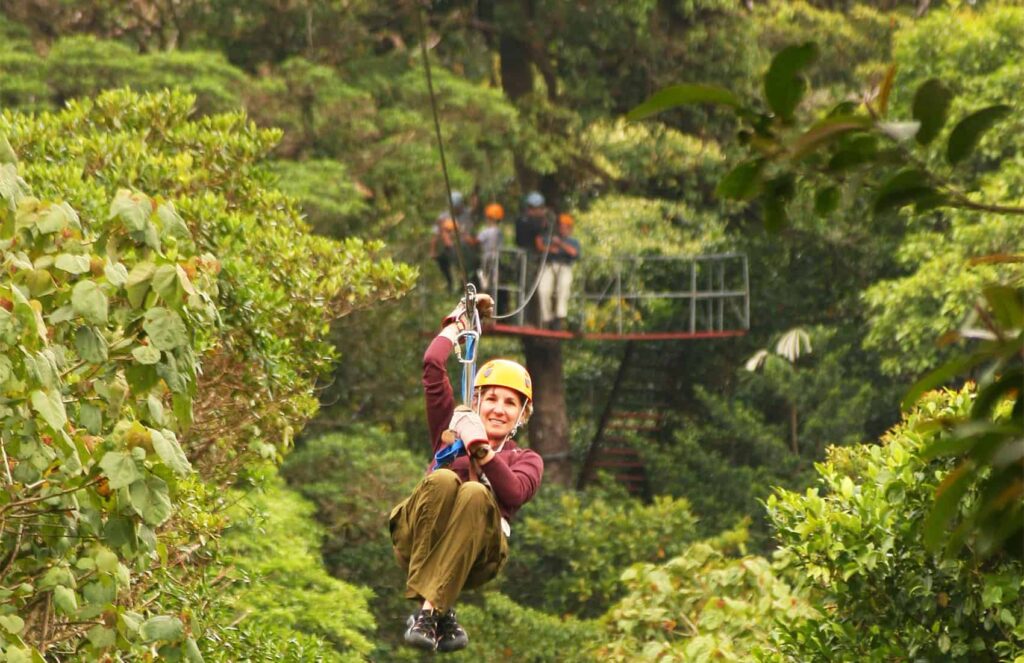
In 1979, an American biologist named Donald Perry strung a cable between two trees in the Monteverde cloud forest so he could study what was happening 100 feet up. He had no idea he had just invented one of the most popular tourist activities on the planet. Today, Costa Rica is the world capital of ziplining — with more than fifty commercial canopy tours strung across its volcanoes, beaches, and cloud forests. Here’s how to pick the right one.
Where it started
Costa Rica invented the canopy tour
The zipline as you know it — the harness, the trolley, the line strung between platforms in the rainforest canopy — was born in Costa Rica. Donald Perry’s original 1979 setup in Monteverde was strictly for science, but a Canadian engineer named Darren Hreniuk saw the recreational potential and opened the first commercial canopy tour in Monteverde in 1997. It took maybe eighteen months for the idea to spread to every other tourism country on Earth, but Costa Rica still does it best — and on a scale nobody else has matched.
The reason is the terrain. Costa Rica’s central spine is a chain of volcanoes covered in primary rainforest and cloud forest. The country drops from those mountains to the Pacific in roughly two hours of driving, which means operators can string cables across deep canyons, between volcanic ridges, or directly above the ocean. There is nowhere else in Central America where you can ride a kilometer-long cable through a cloud forest in the morning and fly nearly a mile over the Pacific in the afternoon.
Pick your region
Where to zipline in Costa Rica
Costa Rica’s three main zipline regions each offer a different experience. The cables themselves are similar across operators — what changes is what you’re looking at on the way down.
Arenal / La Fortuna — volcano views
Guanacaste — ocean views
Manuel Antonio — coastal rainforest
Monteverde — the original cloud forest tour
This is where the sport was invented and where the cloud forest backdrop still beats anywhere else in the country. You’re zipping through low-hanging mist with the canopy directly below you, and on a good day you’ll glide past resplendent quetzals and emerald toucanets. The trade-off: the misty, cool weather that defines Monteverde also means your views can be socked in. Mornings are clearer than afternoons.
Arenal / La Fortuna — fast lines with volcano views
The Arenal area has the longest, fastest cables in the country aimed straight at the active volcano. Lake Arenal stretches out below you on one side, the conical silhouette of the volcano fills the horizon on the other, and the rainforest hugs the cables on both sides. This is the region for travelers who want the fastest ride and the most iconic Costa Rica view in the same flight.
Guanacaste — flying over the Pacific
Guanacaste’s dry forest and coastal terrain make this the region for ocean-view ziplining. The marquee experience here is the Diamante Eco Adventure Park “Superman” cable, which sends you nearly a mile face-first toward the Pacific. It’s also the easiest region to reach — most operators are within 30 minutes of Liberia International Airport, which makes ziplining a viable first-day activity if you fly in early.
Manuel Antonio / Quepos — coastal jungle
The Central Pacific operators string their cables through coastal rainforest with glimpses of beach. Lines here tend to be shorter and the parks smaller, but the wildlife is excellent — capuchin monkeys, sloths, and toucans are routine sightings from the platforms. Best for travelers who are already in Manuel Antonio and want to fit ziplining into a beach-focused trip.
Top operators
The parks worth booking
Costa Rica has more than fifty zipline operations, but a handful stand out for engineering quality, ACCT safety certification, and consistent reviews. Here are the ones that are worth the drive.
Selvatura Park
The classic cloud forest canopy course
- Cables: 13 lines, 18 platforms
- Longest: 1 km
- Extras: Tarzan swing, Superman line
- Min. age: 4 (with adult)
The most extensive course built entirely inside the cloud forest reserve. You hike uphill between some platforms, which keeps it feeling like a forest experience rather than a theme park. Good for travelers who want the cloud forest immersion alongside the adrenaline.
Sky Adventures Monteverde
Auto-brake cables, no manual stopping
- Cables: 7 lines + Sky Tram
- Longest: ~750 m
- Extras: Vertigo Drop, Tarzan swing
- Min. height: 1.2 m
Long landing platforms and automatic braking mean you keep your hands on the trolley the entire ride. Easiest course for families, first-timers, and anyone nervous about the manual leather-glove braking used at other parks.
100% Aventura
Home of the Superman 1 km cable
- Cables: 10 lines + Tarzan swing
- Longest: Over 1 km Superman
- Extras: Tunnel ride, rappel
- Min. age: 5+
Two Superman-style cables, one of which passes through a dark tunnel cut through a hillside. The most theatrical Monteverde experience and a favorite for thrill-seekers who don’t mind a manual brake.
Sky Adventures Arenal
Volcano views at 70 km/h
- Cables: 7 lines + Sky Tram
- Longest: ~750 m (2,460 ft)
- Top speed: ~70 km/h (43 mph)
- Min. age: 5+ (1.1 m height)
The same automatic-brake system as their Monteverde park, but the views are different — you’re flying with Arenal Volcano on one side and Lake Arenal on the other. Sister Sky Walk hanging-bridge trail can be added as a combo.
Diamante Eco Adventure Park
Longest ocean-view zipline in Central America
- Cables: Multi-line course
- Longest: ~1.6 km (1 mile) Superman
- Extras: 30 ft Quick Jump, animal sanctuary
- Min. age: 5+
The nearly mile-long Superman line flies face-first toward the Pacific. The only dual ocean-view cable in the country — you can ride side-by-side with a partner. 30 minutes from Liberia airport, making it the easiest first-day activity from a Guanacaste arrival.
Rainforest Adventures (Braulio Carrillo)
The easy day trip from San José
- Cables: 10 lines
- Longest: ~3,000 ft “Adrena Line”
- Setting: Primary rainforest, aerial tram
- Min. age: 4+
An hour from San José in Braulio Carrillo National Park — the most accessible zipline for travelers who can’t get to Arenal or Monteverde. Pairs well with the operator’s aerial tram for a half-day rainforest experience.
Money
How much ziplining costs in Costa Rica
Pricing varies by park, season, and whether you’re booking a standalone tour or a combo. As of 2026, expect roughly the following ranges.
| Tour type | Adult price | What’s included |
|---|---|---|
| Standalone zipline (2 hrs) | $55 – $95 | 7 to 13 cables, gear, bilingual guides |
| Zipline + hanging bridges combo | $95 – $135 | Cables plus 1.5 to 2 hr canopy walk |
| Full-day adventure pass | $125 – $165 | Zipline + tram + bridges + lunch |
| Hotel transport add-on | $15 – $25 pp | Round-trip pickup from major towns |
| Photo / video package | $35 – $60 | GoPro footage + stills, USB or digital |
Children typically pay 25–35% less than adults. Many parks charge a peak-season surcharge (around $10 extra per person) during Christmas–New Year and Easter weeks. Booking directly through the operator’s website is often cheaper than booking through Viator or your hotel concierge, though the difference is small.
Insider tip
Almost every park offers a combo discount. If you’re going to do ziplining and hanging bridges in the same area anyway, booking them together at one park can save 20–30% over booking them separately at two different operators. Just confirm both activities are at the same location — some “combo” packages shuttle you between parks and eat half your day in transit.
Restrictions
Age, weight, and health requirements
Costa Rican zipline operators are stricter about requirements than most travelers expect. The standard limits across the major parks are:
- Minimum age: 4 to 5 years old at most parks. Children under 10 typically must ride tandem with a guide, though some parks allow younger kids to ride solo if they meet the height minimum.
- Minimum height: Around 1.1 m (3’7″) at most parks. This is harder to meet than the age requirement for some smaller kids.
- Maximum weight: 250 to 300 lbs (113 to 136 kg). The cable systems are designed for this range; exceeding it isn’t allowed regardless of fitness level.
- Minimum weight: No formal minimum, but very light children (under about 40 lbs) may not generate enough momentum to reach the next platform and will ride tandem with a guide.
When ziplining isn’t recommended
Most operators will turn you away if you are pregnant, have had recent surgery (within the past year, particularly on the back, neck, abdomen, or limbs), or have significant heart, back, or neck conditions. The harness puts real pressure on your groin and lower back, and the sudden stops at the end of each cable jolt the spine. If you’re unsure, ask your doctor before booking — not after you’ve already driven two hours and paid.
Safety
How to know an operator is safe
Costa Rica’s tourism industry is broadly well-regulated, but ziplining sits in a gray area where roadside operators occasionally pop up without proper engineering certification. The good news is that the major parks listed above all meet international safety standards. Here’s what to look for if you’re considering a smaller or less-reviewed operator:
- ACCT certification. The Association for Challenge Course Technology sets the international standard for zipline engineering. Major Costa Rican parks like Diamante and Sky Adventures advertise this prominently. If a park doesn’t mention any safety certification anywhere on its website, that’s a flag.
- Redundant safety lines. You should be attached to the cable with two carabiners, not one. The trolley is the primary; the secondary lanyard is your backup if the trolley fails.
- Daily cable inspections. Reputable parks inspect every cable and platform before the first tour of the day. Ask if you’re unsure.
- Trained bilingual guides. You want at least two guides on the course at all times — one to send you off, one to catch you at the other end. Solo-guide operations are a hard no.
- Real reviews. Tripadvisor, Google, and Viator reviews from the last six months tell you more than any marketing copy. If a park has 2,000+ positive reviews and an established website, you’re fine.
Practical
What to wear and bring
Ziplining is more physical than most travelers expect. You’ll be hiking between some platforms, harnessing up in tropical humidity, and sometimes getting rained on. Plan accordingly.
- Closed-toe shoes — mandatory at almost every park. Sneakers, hiking shoes, or sport sandals with heel straps work; flip-flops do not. If you show up in sandals, you’ll be sent home or charged a rental fee.
- Athletic pants or shorts that cover your thighs — the harness chafes against bare skin. Leggings or quick-dry hiking pants are ideal.
- A snug shirt — loose shirts ride up under the harness.
- Hair tied back for anyone with long hair — it can catch in the trolley.
- A small dry bag or zippered pocket for your phone. Most parks offer free lockers; if you bring a phone on the course, secure it.
- Bug spray and sunscreen applied before you arrive — you won’t have time on the platforms.
- Light rain jacket if you’re in cloud forest or rainy season. Tours generally run rain or shine.
Timing
Best time of year to zipline
Ziplining runs 365 days a year across Costa Rica, but the experience changes with the seasons.
Dry season (mid-December through April) is the most reliable. Clear skies, fast cables, and the best photo conditions — especially important in Guanacaste and Arenal where the views are the whole point. The trade-off is that this is also peak tourist season, so book at least a few days ahead.
Green season (May through mid-November) is wetter, cheaper, and quieter. The cables still run rain or shine, and the rainforest is at its lush peak. You may get rained on during the tour, but the visibility tends to be better than people expect — clouds typically build in the afternoon, so book a morning slot. September and October are the wettest months and the only stretch where tours occasionally cancel for thunderstorms or high winds.
Morning is better than afternoon in every region. Cloud forest mist clears in the morning, ocean wind is gentler before midday, and afternoon thunderstorms in green season are most likely to scuttle a tour.
For your itinerary
If you’re planning a Costa Rica trip and want to zipline once, the choice of region depends on your route. Hitting Arenal? Sky Adventures pairs perfectly with a Mistico Hanging Bridges and hot springs day. Going to Monteverde? Selvatura or 100% Aventura — both are within walking distance of Santa Elena. Flying into Liberia and staying at a Guanacaste beach resort? Diamante is the obvious answer, and you can knock it out on arrival day. Don’t drive three hours out of your way to zipline somewhere else — the cables are similar across the country, and the regional view is what makes the experience.
Final word
Pick a region, book ahead, wear closed shoes
Ziplining is the rare tourist activity that lives up to the hype. The cables are safe, the views are real, and the engineering is genuinely world-class — Costa Rica has been doing this longer than anywhere else on the planet. The only real ways to screw it up are showing up in flip-flops, booking at a sketchy roadside operation, or driving four hours out of your way when there’s a perfectly good park 20 minutes from your hotel.
Pick the region that matches your trip, book one of the established parks, and you’ll be flying through the canopy within an hour of arrival. The first cable is the scary one. By the third, you’ll be looking around.
Pura Vida
Costa Rica gave the world the zipline. Forty-seven years later, it’s still the best place to ride one.