

Seeing a toucan is high on most visitors’ Costa Rica wish lists, and it’s one of the easier wildlife goals to hit. Costa Rica has six toucan species: two large toucans, two aracaris and two toucanets. Which ones you see depends mostly on which side of the country you’re on and how high up you are. This guide covers all six toucans in Costa Rica, where each one lives and how to improve your odds of a good sighting.
Toucans in Costa Rica at a Glance
| Species | Length | Where in Costa Rica | Good places to look |
|---|---|---|---|
| Yellow-throated toucan | 19–24 in. (47–61 cm) | Caribbean slope and the Pacific from Carara south | Tortuguero, Sarapiquí, Carara, Manuel Antonio, Osa |
| Keel-billed toucan | 16.5–21.5 in. (42–55 cm) | Caribbean slope and northern lowlands | Tortuguero, La Selva, Arenal |
| Collared aracari | Medium-sized | Caribbean lowlands and foothills, parts of Nicoya | Tortuguero, Sarapiquí |
| Fiery-billed aracari | About 18 in. (45 cm) | Southern Pacific, from the Gulf of Nicoya south | Carara, Manuel Antonio, Osa |
| Emerald toucanet | 12–14 in. (30–35 cm) | Middle and high elevations | Monteverde, highland lodges |
| Yellow-eared toucanet | 14–15 in. (36–38 cm) | Wet foothill forest, mostly 1,000–3,600 ft. (300–1,100 m) | Arenal area, Caribbean foothills |
Where to See Toucans in Costa Rica
Think in regions, not species. Costa Rica’s mountains split the country into a Caribbean side and a Pacific side, and the toucans split along the same lines.
Caribbean Side and Northern Lowlands
This is the home of the keel-billed toucan, the rainbow-billed bird on postcards. You’ll also find the yellow-throated toucan and the collared aracari here. Tortuguero, the Sarapiquí area around La Selva Biological Station and the lowlands around Arenal are all reliable. The foothills around Arenal are also one of the better areas for the hard-to-find yellow-eared toucanet.
Central and Southern Pacific
South of the Gulf of Nicoya, the cast changes. The yellow-throated toucan is the big toucan here, and the fiery-billed aracari, a bird found only in Costa Rica and western Panama, replaces the collared aracari. Carara National Park, Manuel Antonio and Corcovado on the Osa Peninsula are good bets. Don’t expect keel-billed toucans in this part of the country.
Highlands and Cloud Forest
At middle and high elevations, the emerald toucanet takes over. It’s common in and around Monteverde and often shows up at lodge feeders. If you’re heading there, our guide to things to do in Monteverde covers the reserves and trails.
The Six Toucan Species in Costa Rica
Yellow-Throated Toucan

The largest toucan in Costa Rica, at 19 to 24 inches. It has a black body, a bright yellow throat and bib, and a two-tone bill: yellow on top and dark chestnut below. Older field guides call it the chestnut-mandibled toucan, and many guides and lodges still use that name.
You’ll hear it before you see it. Its call is a series of loud, far-carrying yelps, often from the top of a tall tree at dawn or late afternoon. It lives up to about 3,900 feet (1,200 meters) on the Caribbean side and on the Pacific from Carara south, which makes it the toucan most visitors to Manuel Antonio and the Osa see.
Keel-Billed Toucan

The keel-billed toucan has the famous bill: mostly green, with orange on the sides, blue on the lower edge and a red tip. The body is black with a yellow chest and red under the tail, and adults run 16.5 to 21.5 inches. Its call is a dry, frog-like croak that’s easy to mistake for an amphibian.
It’s most abundant on the Caribbean slope and in the northern lowlands, and it travels in small, noisy groups. Tortuguero, La Selva and Arenal are among the most dependable places to see one.
Collared Aracari
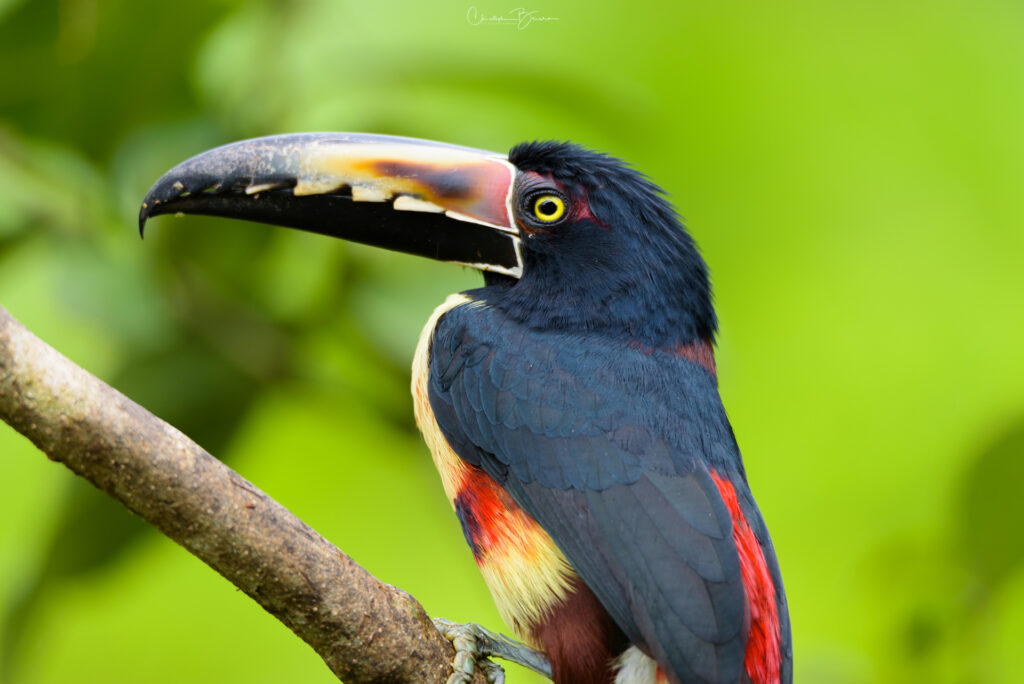
Aracaris are smaller, slimmer toucans that move in busy groups. The collared aracari has a black head, a yellow chest with a black spot and a red band, and a pale upper bill. It lives in the lowlands and foothills of the Caribbean slope, plus parts of the Nicoya Peninsula. Groups often number eight or more, and they’re active predators of other birds’ eggs and nestlings as well as fruit eaters.
Fiery-Billed Aracari
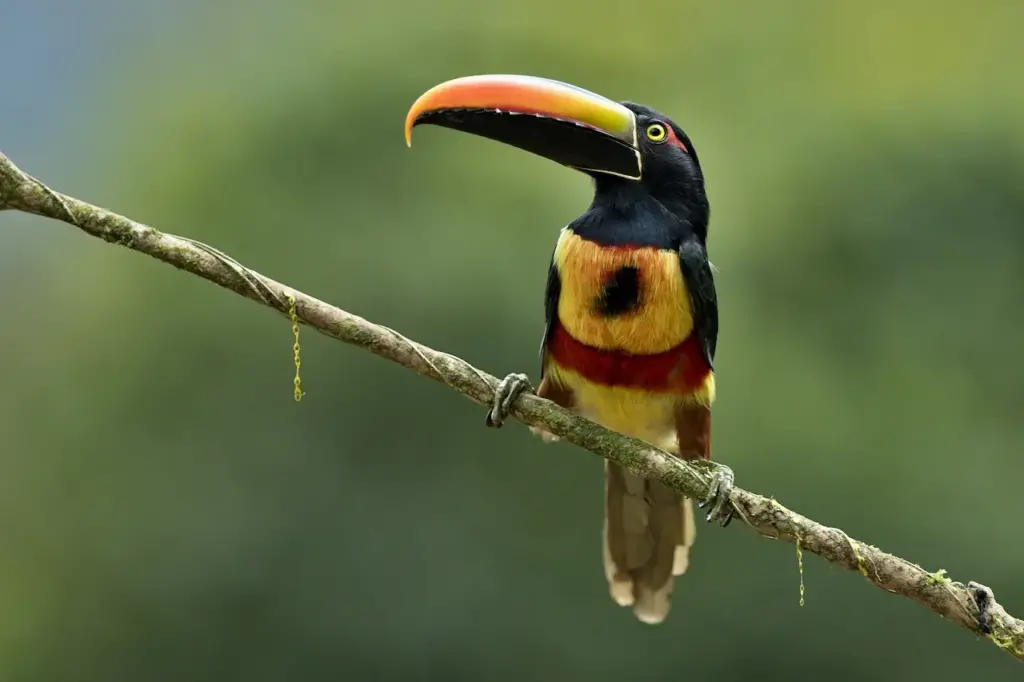
The fiery-billed aracari is the southern Pacific counterpart of the collared aracari, with an orange-red upper bill and a red band across a yellow chest. It’s about 18 inches long and lives only in Costa Rica and western Panama, from the Gulf of Nicoya south, from sea level to around 3,900 feet (1,200 meters).
Look for groups of six or more moving through fruiting trees in Carara, Manuel Antonio and the Osa. Several birds often roost together in a single tree cavity at night.
Emerald Toucanet

The emerald toucanet is the smallest of the group at 12 to 14 inches, and almost entirely green, which makes it surprisingly hard to pick out of a cloud forest canopy. Its bill is black and yellow. Taxonomists have split and renamed this bird several times, so you may see the Costa Rican form listed as the northern emerald toucanet or the blue-throated toucanet.
It lives in middle and high elevation forests, travels in pairs or small family groups and gives a dry, barking call. It’s also one of the main predators of resplendent quetzal nests, which is worth remembering if you watch a quetzal nest and a toucanet shows up.
Yellow-Eared Toucanet
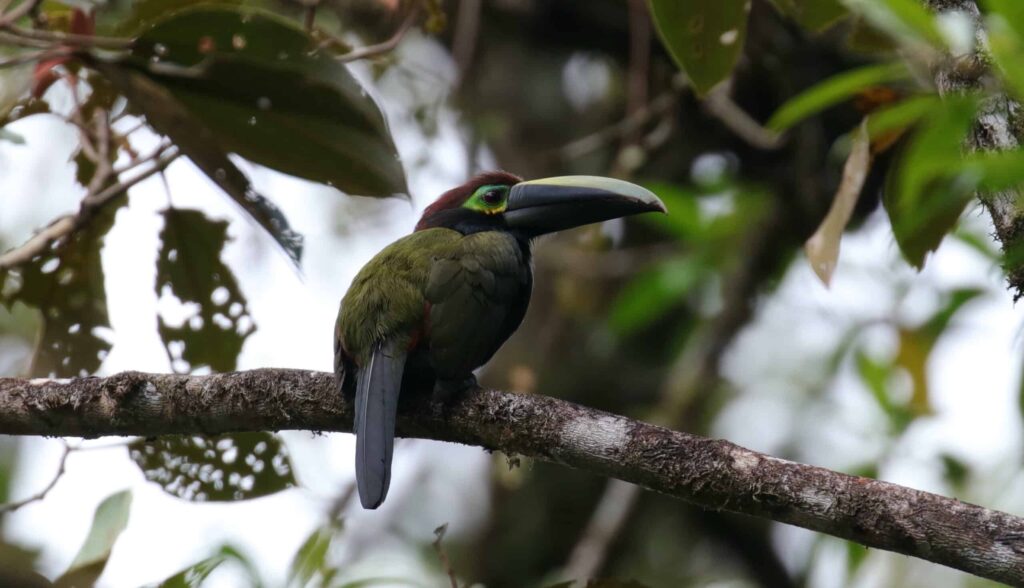
The toughest of the six to find. The yellow-eared toucanet is 14 to 15 inches long and mostly black. Males have a bold yellow tuft behind the eye, which gives the bird its name. Females have a chestnut forehead and hindneck and lack the yellow ear tuft.
It lives in wet forest on slopes and ridges, mostly between about 1,000 and 3,600 feet (300 to 1,100 meters), and it’s less social than other toucans, usually foraging in pairs or small groups. The Arenal area is one of the better places to try. A local birding guide makes a big difference with this one.
What Toucans Eat
Fruit makes up most of the diet, and toucans swallow many fruits whole and pass the seeds, which helps spread fruiting trees through the forest. They also eat insects, lizards and the eggs and chicks of other birds, especially when feeding their own young. All of Costa Rica’s toucans nest in tree cavities.
Tips for Spotting Toucans
- Go early. The first two hours after sunrise are the most active. Late afternoon is the second-best window.
- Listen first. The keel-billed toucan’s croak and the yellow-throated toucan’s yelping carry a long way. Follow the sound to the treetops.
- Find fruiting trees. A tree full of ripe fruit or figs draws toucans and aracaris back again and again.
- Check lodge feeders. Emerald toucanets visit feeders regularly, and yellow-throated toucans occasionally do.
- Bring binoculars. Toucans often sit high in the canopy. A decent compact pair helps. See our binocular picks for birders and hikers.
- Hire a guide for the hard ones. A local guide with a spotting scope is the fastest route to the yellow-eared toucanet or a close look at any species.
Common Mistakes to Avoid
- Looking for keel-billed toucans in the south Pacific. In Manuel Antonio and the Osa, your big toucan is the yellow-throated.
- Scanning only eye level. Most sightings come from high branches and the tops of tall trees.
- Feeding wild toucans. Don’t. Lodges that put out fruit manage their feeders; tourists should not hand-feed wildlife.
- Sleeping through the morning. By late morning in the lowland heat, activity drops off sharply.
Toucans in Costa Rica: Frequently Asked Questions
How many types of toucans live in Costa Rica?
Six: the yellow-throated toucan, keel-billed toucan, collared aracari, fiery-billed aracari, emerald toucanet and yellow-eared toucanet.
Which toucan am I most likely to see?
On the Caribbean side and in the northern lowlands, the keel-billed toucan and collared aracari. On the central and southern Pacific, the yellow-throated toucan and fiery-billed aracari. In Monteverde and other highland areas, the emerald toucanet.
Can you see toucans in Manuel Antonio?
Yes. The yellow-throated toucan and the fiery-billed aracari both live in and around the park. Mornings are best, and a guide with a scope helps.
What is the largest toucan in Costa Rica?
The yellow-throated toucan, which can reach about 24 inches (61 cm) including its bill.
Are toucans endangered in Costa Rica?
None of the six is listed as endangered, but habitat loss and forest fragmentation put pressure on all of them, and the illegal pet trade remains a problem. Protected areas and forest corridors are a big part of why toucans are still easy to see in Costa Rica. For more of the country’s signature wildlife, see 9 iconic animals you can see in Costa Rica and our guide to birding in Costa Rica.