
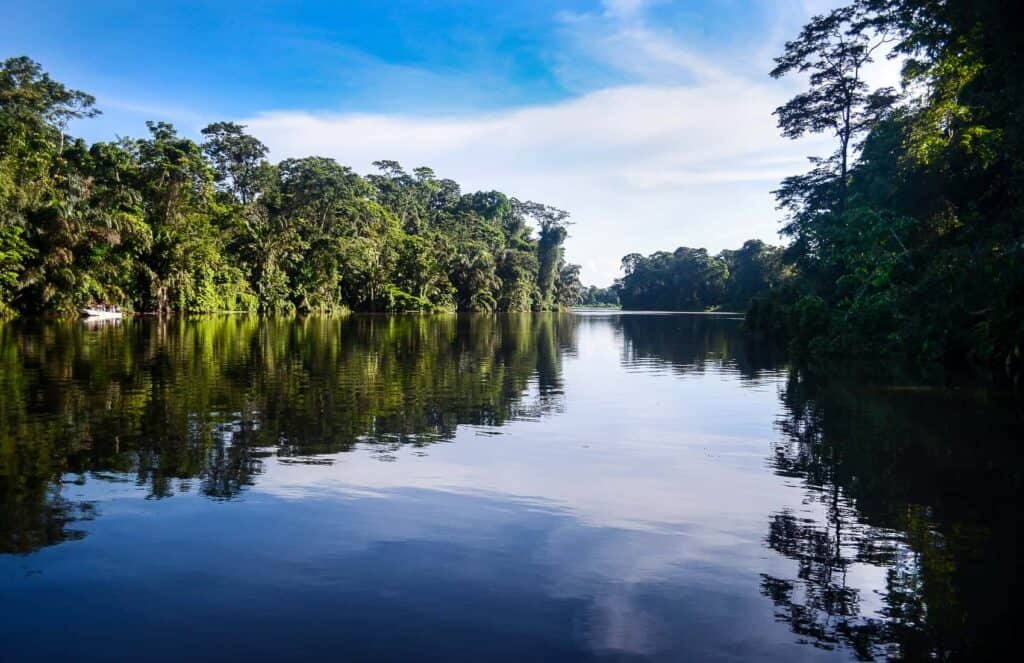
Plug Tortuguero into Waze and it will happily route you somewhere. It will not route you there. No road reaches the village, no road reaches the nesting beach, and no rental car will change that — the last leg is a boat or a very small plane, and that is the whole reason the place still looks the way it does.
Tortuguero sits on a narrow sandbar on Costa Rica’s northern Caribbean coast, pinned between the sea and a maze of freshwater canals. To reach it you drive to a dock and get out. Two routes carry almost everyone: a public boat from La Pavona, about 1.5 hours through the canals, or a 35-minute flight from San José to a grass airstrip a five-minute boat ride from town.
- By boat. Drive, bus, or shuttle to La Pavona dock, then a public lancha to the village dock.
- By air. Sansa flies San José to Tortuguero (TTQ) in about 35 minutes.
- By boat from the south. Moín, near Limón, is a longer and less reliable crossing.
Getting There
How to get to Tortuguero without a car
From San José, the standard route is Highway 32 over the mountains to Guápiles — a drive that cuts straight through Braulio Carrillo National Park — then north through Cariari to La Pavona. That’s three to four hours of driving, or the same trip by public bus for well under $20. La Pavona has a guarded parking lot at roughly $5 to $8 a day, a restaurant, and a ticket window. You buy the boat ticket in person, in cash: about ¢3,000 to ¢6,000, or $6 to $12, depending on the operator and your luggage.
Boats run roughly hourly from 7 a.m. to 4:30 p.m. in both directions, and the ride is no chore. You pass howler monkeys, caimans on the mud banks, herons, and kingfishers — most people rate it among the better wildlife hours of their trip.
| Route | Time | Cost, one way | Best for |
|---|---|---|---|
| San José → La Pavona → boat | 5–6 hrs total | $15–$25 by bus | Most travelers, any budget |
| Private shuttle + boat | 5 hrs | $250–$300 per vehicle | Families, tight schedules |
| Sansa flight from San José | 35 min | $115–$155 | Short trips, no patience for buses |
| Moín dock, near Limón | 3–4 hrs by boat | $35–$50 | Arriving from Puerto Viejo or Cahuita |
Silt at the mouth of the Río Parismina has made the Moín and Caño Blanco crossings unreliable, especially at low tide, and commercial traffic has shifted to La Pavona. If you’re coming up the Caribbean coast, confirm the crossing with your lodge before committing to it.
Two logistical facts that catch people out. First, luggage goes on the boat with you and boats get wet, so pack light and bring a dry bag. Second, Tortuguero has no dependable ATM — this is one of the places where carrying cash in Costa Rica stops being optional. Bring colones and small dollar bills for boat fares, tours, sodas, and tips.
Timing
When to go for turtle nesting
Tortuguero is the most important green turtle nesting site in the Caribbean, and the season is narrow. The regulated nesting tours run July 1 through Oct. 31. Come in May hoping for green turtles and you’ll be two months early — though you may catch a leatherback, which is a very different and much larger animal. Costa Rica hosts five nesting species in total, and our turtle nesting guide breaks down which coast to be on for each.
Nesting is the reliable thing to plan around. Hatching is not — eggs take 45 to 65 days, and emergence depends on sand temperature and weather. Treat hatchlings as a bonus, and September as your best odds of seeing both in one trip.
Tours leave at 8 p.m. and 10 p.m. with a park-certified guide, cost about $35 to $40 per person, and are capped — no more than 200 people on the beach at a time. Wear dark clothing. No cameras, no phone screens, no flashlights. Everyone is off the beach by midnight. Book through your hotel the morning of, not the evening of.
The Park
What to do in the canals
The turtles get the headlines; the canals are what most visitors remember. Tortuguero National Park protects 19,000 hectares of rainforest, mangrove, and waterway, and the aquatic trails are the main way through it. Admission is $15 plus 13% tax — roughly $17 per adult, $5 per child — and you can buy park tickets online through SINAC before you arrive. The park is open daytime hours only.
Go early. The 6 a.m. boat is worth the alarm: wildlife is active, the water is glass, and the afternoon rain hasn’t arrived. Caño Chiquero and Caño Mora are closed to motors and open only to canoes, kayaks, and electric boats, which is exactly why they’re the best of the network. Expect caimans, three species of monkey, river otters, toucans, and, with luck, a manatee — our month-by-month wildlife calendar covers what’s active when.
- Guided canoe or kayak. Two hours, roughly $25 to $60 depending on group size and operator.
- Motorized canal tour. Covers more ground; better for birds, worse for silence.
- Night jungle walk. About $20, and the frogs and insects are the point.
- Cerro Tortuguero and the Jaguar Trail. A steep viewpoint climb and a 2.5-km beach-side walk. Rent rubber boots.
Lodging
Where to stay: village or canal lodge
This is the trip’s real fork in the road. The village is a 400-meter strip of footpath with cabinas, small hotels, sodas, and tour desks. Rooms start around $30 and cluster in the $40 to $90 range. You eat where you want, book tours a la carte, and walk everywhere.
The canal-side lodges — Mawamba, Pachira, Laguna, Evergreen, Tortuga Lodge — mostly sell two-night packages bundling transport from San José, all meals, and guided tours at $115 to $200 a night, or $450 to $650 per person all in. You trade flexibility for a pool and never having to arrange a boat. Mawamba is the one you can walk to town from; from most others, the village is a boat ride.
Budget
What a two-night trip costs
Two nights is the right length. One night means you spend most of the trip on boats; three is generous unless you’re fishing or birding hard.
Independently, from San José and sharing a room: about $40 round trip in buses and boat fares, $60 to $100 for two nights in a village cabina, $17 to $34 in park fees, $35 for the night turtle tour, $25 to $40 for a canoe tour, and $50 to $70 for food. Call it $230 to $300 per person, all in.
A canal lodge package covering transfers, nine meals, and guided tours runs $450 to $650 per person for the same two nights. Flying instead of busing adds $230 to $310 round trip; a private transfer to the dock is worth pricing if you’re a family of four. Neither approach is wrong — the packages genuinely simplify a complicated arrival, and the independent route buys you the freedom to skip a tour and nap instead.
- Best months: September
- Peak nesting: July–August
- Minimum stay: 2 nights
- Cash only, mostly
- No cars, no roads
Questions
Frequently asked questions
Can you drive to Tortuguero?
No. There is no road into Tortuguero village or to the nesting beach. You drive as far as La Pavona dock, leave the car in the guarded lot for about $5 to $8 a day, and continue by boat. Flying from San José is the only alternative.
Do I need a 4×4 to reach the dock?
Not for La Pavona. The final stretch is dirt but flat and passable in a standard car in normal conditions. Heavy rain can change that, so check locally before setting out.
What is the best month to see turtles in Tortuguero?
September. Green turtle nesting is still underway, the July nests are hatching, crowds are at their thinnest, and it falls in the Caribbean’s brief drier spell. August sees more nesting activity but more visitors.
Can I walk on the nesting beach at night by myself?
No. After 6 p.m. during nesting season the beach is closed to anyone without a park-certified guide, and tour groups are capped. Cameras, phone screens, and flashlights are prohibited.
Is Tortuguero worth it if I miss turtle season?
Yes, for the canals. Monkeys, caimans, otters, and birdlife are there year-round, February through April is the driest stretch, and lodging is at its cheapest. Just don’t come in November expecting turtles.
The short version
Tortuguero rewards travelers who plan around two things: a boat schedule and a nesting calendar. Get the July-to-October window right, book the night tour the morning you arrive, take the 6 a.m. canal trip, and give it two nights.
And leave the car at the dock. That inconvenience is the reason 22,500 turtles still come back here every year.