
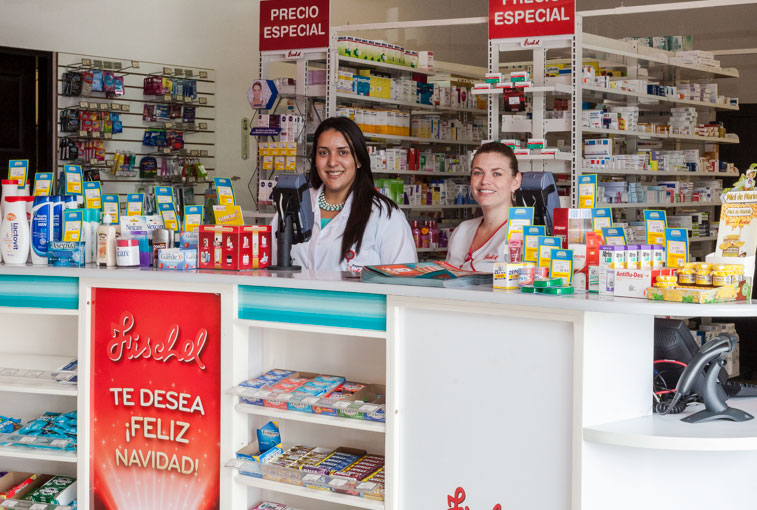
Walk down almost any street in Costa Rica and you’ll spot the same sign: a green cross above a doorway, the word farmacia in white letters underneath. Step inside and you’ll find something American and Canadian travelers rarely expect — a healthcare system within a healthcare system, where the pharmacist behind the counter is your first stop for almost anything that ails you, prices are a fraction of what you’d pay back home, and a friendly conversation in basic Spanish can replace what would have been a $200 doctor’s visit.
The Big Picture
A pharmacy system unlike the one you’re used to
Costa Rica has roughly 1,100 registered pharmacies spread across a country smaller than West Virginia. That density — combined with the unusually broad role pharmacists play here — makes the local farmacia one of the most important places a traveler, expat, or retiree will visit during their time in the country. For many minor health issues, it’s the only place you’ll need to visit at all.
What surprises most newcomers is how much authority Costa Rican pharmacists have compared to their counterparts in the United States, Canada, or the UK. A licensed pharmacist here can diagnose common ailments, recommend treatment, dispense the medication, and even administer injections — all without you ever seeing a doctor. Locals routinely refer to their pharmacist as doctor or doctora, and it’s not just politeness. It reflects how the system actually works.
Pharmacies nationwide
Standard daily hours
Options in the GAM
Medical emergencies
For visitors arriving from countries where pharmacies are little more than a counter at the back of a drugstore, the shift takes some getting used to. But once you understand how the system works — and what you can and can’t get over the counter — you’ll likely find Costa Rica’s pharmacy culture one of the most pleasant surprises of your trip.
The Rules
Who runs the show: regulation and oversight
Every legitimate pharmacy in Costa Rica is regulated by two entities working in tandem. The Ministerio de Salud (Ministry of Health) is the rector of the country’s health system and licenses pharmacies under a framework known as the Manual de Normas para la Habilitación de Farmacias (Decree 31969-S). The Colegio de Farmacéuticos de Costa Rica is the professional college that registers and qualifies every working pharmacist.
The practical takeaway for you: any pharmacy you walk into legally must have a licensed pharmacist (the regente farmacéutico) on duty during operating hours, must display its Ministry of Health permit visibly on the wall in the main area, and must also display a separate sanitation permit. If you don’t see these documents posted, you’re in the wrong place.
Look for the green cross sign with “Farmacia” in white letters — the same symbol used across most of Europe and Latin America. Inside, the wall behind the counter should display two official permits from the Ministerio de Salud. The pharmacist on duty will typically wear a white coat and a name tag identifying them as a licensed regente.
This regulatory backbone matters because it underwrites the trust that locals place in their pharmacist. Costa Rica has none of the loose, unregulated medicine bazaars you might find in some other parts of Latin America. Drugs sold in registered pharmacies are sourced through licensed importers and distributors, with the Caja Costarricense de Seguro Social (the national health system) and the Ministry of Health jointly approving what gets to market.
Chain Vs. Independent
The major pharmacy chains you’ll see everywhere
While Costa Rica’s pharmacy market is dominated by independent neighborhood shops, a handful of national chains have aggressively expanded over the last fifteen years. Knowing them helps you orient quickly when you arrive in a new town.
Farmacia Fischel
The convenience leader. The largest chain in the country with over 100 locations, including many co-located inside Automercado supermarkets in the Central Valley. Fischel positions itself on convenience rather than rock-bottom prices. Owned by the Cuestamoras group.
Farmacia La Bomba
The discount leader. Acquired by the same Cuestamoras group as Fischel, but operated as a separate low-price brand. Locations across all seven provinces, free delivery within the Greater Metropolitan Area, and a “guaranteed lowest price” policy.
Farmacia Sucre
The digital convenience chain. Around 66 locations with a strong online ordering platform. Popular in the Central Valley and along the Pacific coast tourist corridors.
FarmaValue
The regional discounter. A Central American chain (also operating in Panama) that entered Costa Rica in 2011. Around two dozen locations focused on low prices, with growing presence in San José suburbs.
Walmart Pharmacy
Inside the big-box store. Around 60 pharmacy counters inside Walmart, Más x Menos, and Maxi Palí supermarkets. Often the easiest one-stop option if you’re already grocery shopping.
Independent farmacias
The neighborhood option. Hundreds of small independents — often the best for personal service and local knowledge, especially in beach towns and rural areas. Prices vary widely; it always pays to compare.
Prices for the same medication can vary substantially between stores in Costa Rica, and that variation tends to be larger than what you’d see between, say, two CVS locations in the same American city. If you’re filling a prescription you’ll be on for weeks or months, it genuinely pays to call two or three pharmacies and compare. Generics in particular can swing 30% or more in price between a discount chain like La Bomba and a convenience-focused outlet like Fischel.
What’s On The Shelf
Over-the-counter rules: more permissive than you think
This is the single biggest difference between Costa Rica and the US or Canada, and it surprises travelers every time. Many medications that strictly require a prescription back home are sold over the counter here after a short conversation with the pharmacist.
That includes things like blood pressure medication, birth control pills, antibiotics for common infections (in many but not all cases), some antidepressants and sleeping pills, anti-inflammatories at prescription strength, Viagra, and a wide range of dermatology preparations. Pharmacists are trained to take a brief medical history, ask about your symptoms, check basic vitals like blood pressure if needed, and recommend a treatment course.
Despite the general permissiveness, Costa Rica strictly controls three categories: narcotics (opioid painkillers like morphine, oxycodone, codeine combinations), psychotropics (benzodiazepines like Xanax, Valium, and Klonopin; stimulants like Adderall and Ritalin), and certain restricted antibiotics. These require a prescription from a Costa Rican physician or, with the right documentation, from your home doctor.
The reasoning behind the more relaxed approach is partly economic — Costa Rica’s pharmacist-led model saves the public health system enormous money on minor consultations — and partly cultural. Pharmacists train for five years at university and are considered front-line healthcare providers, not just dispensers. The flip side, as Costa Rican health authorities themselves acknowledge, is a tendency toward self-medication that can mask more serious conditions. Use the system, but don’t replace genuine medical care with a pharmacy visit if something feels wrong.
Bringing It With You
Travelers: what to do before you arrive
If you’re coming to Costa Rica for a vacation or extended stay, the smartest move is to bring your own medications rather than rely on local pharmacies for prescription refills. The reasoning has nothing to do with quality — Costa Rican pharmacies stock high-quality drugs from reputable manufacturers — and everything to do with branding and formulation.
A drug you take at home may be sold under a completely different brand name here, or in a different dosage strength, or as a slightly different formulation that doesn’t sit quite the same way with your body. There have been documented cases of travelers picking up what they believed was the same medication and finding it didn’t work the same way.
The CDC and the US State Department both recommend the same approach for any international trip, and Costa Rica is no exception. The generic-name letter is the single most useful document you can carry, because Costa Rican pharmacists will recognize a generic name like “atorvastatin” instantly even if they’ve never heard of your specific brand.
If you’re traveling with ADHD medication (Adderall, Ritalin, Concerta), anti-anxiety prescriptions (Xanax, Valium, Ativan), opioid painkillers, or sleeping pills like Ambien, get a doctor’s letter explicitly listing the medication, dosage, and reason for prescription — ideally with a Spanish translation. Customs officers rarely inspect personal medication in reasonable quantities, but if questioned, you’ll want documentation that matches what’s in the bottle.
Costa Rica requires that you bring only enough medication to cover the length of your stay — large stockpiles can raise questions at customs. A few weeks’ supply with a buffer for delays is appropriate; a six-month supply for a two-week trip is not.
Living Here
Expats and retirees: the long game
Once you’ve made the move to Costa Rica — whether as a pensionado, rentista, or under another residency category — your relationship with the local pharmacy changes entirely. You’re no longer trying to make a foreign system work for a short trip; you’re integrating into a national healthcare structure that, for most people, ends up being a significant upgrade.
The Caja: free medications for legal residents
Joining the Caja Costarricense de Seguro Social (CCSS, almost always shortened to “the Caja”) is mandatory for legal residents and is part of the residency application itself. Your monthly contribution is calculated as a percentage of your declared income, and once you’re enrolled, prescription medications dispensed through the public system are entirely free.
That’s not a typo. If your Caja-affiliated doctor prescribes a medication that’s on the CCSS formulary, you walk down the hallway, hand the prescription to the pharmacist at the Caja pharmacy, and walk out with your medication at zero cost. For retirees on long-term maintenance medications — blood pressure, cholesterol, diabetes management — this single benefit can save thousands of dollars a year.
Free GP and specialist consultations, hospital care including surgery, lab work and imaging, and all prescription medications on the national formulary. The system has roughly 40 public hospitals and over 250 clinics nationwide. Wait times for non-emergency procedures can be long, which is why many expats also carry private insurance.
When the Caja doesn’t have your drug
The CCSS formulary covers the vast majority of common medications but doesn’t include every drug on the market. If your prescription isn’t on it, your doctor can either substitute an equivalent that is covered, or you can buy the original drug at a regular farmacia at retail price. Even then, retail prices in Costa Rica run a fraction of what the same drug costs in the United States — often 30 to 70 percent less.
Private insurance and the hybrid approach
Most expats who can afford it combine Caja membership with a private insurance plan, either through INS (the national insurance institute), a Costa Rican private insurer, or an international health plan. The private side gets you shorter wait times, English-speaking doctors, and access to the country’s excellent private hospital network — Clínica Bíblica, CIMA, Hospital Metropolitano, Clínica Católica — while the Caja serves as the backstop for major medical events and ongoing prescription coverage.
Speak The Language
Useful Spanish for the pharmacy counter
Most pharmacists in tourist areas speak some English, but even a few words of Spanish goes a long way and dramatically reduces the chance of a “lost in translation” mix-up with your medication.
The Travel Kit
What to actually buy at a Costa Rican pharmacy
Beyond filling prescriptions, the farmacia is the first stop for the small medical inconveniences that come with tropical travel. A few things worth knowing what to ask for:
Bloqueador solar (sunscreen)
Suero oral (oral rehydration)
Loperamida (Imodium)
Antiácidos (antacids)
Crema para picaduras (bite cream)
Aloe vera puro
Acetaminofén / Ibuprofeno
Antihistamínicos (antihistamines)
Sunscreen and insect repellent are noticeably more expensive at airport shops and tourist beach kiosks than at a regular pharmacy in town — sometimes double the price. If you’re staying any length of time, stock up at a farmacia, not a souvenir shop. The same goes for things like contact lens solution, basic first aid supplies, and over-the-counter pain relievers.
Hours & Access
When pharmacies are open (and when they’re not)
Standard pharmacy hours in Costa Rica are 8:00 AM to 8:00 PM Monday through Saturday, with slightly shorter hours on Sundays — typically 8:00 AM to 6:00 PM. Rural pharmacies may close earlier and may not open at all on Sundays. National parks, wildlife refuges, and remote stretches of the Caribbean and Osa Peninsula generally have no pharmacy access whatsoever.
In the Greater Metropolitan Area — San José, Heredia, Alajuela, Cartago — you can find 24-hour pharmacies, particularly attached to or near the major private hospitals. Clínica Bíblica, CIMA Hospital, Hospital Metropolitano, and Hospital Clínica Católica all have round-the-clock pharmacy access for genuine emergencies.
Plan ahead. A small beach town like Sámara, Montezuma, or Puerto Viejo will have a pharmacy or two, but it may close by 7 PM and may not reopen until Monday morning. Stock your travel kit before heading out of San José or Liberia, and don’t assume you can pick up forgotten essentials at midnight in a rural area.
FAQ
Common questions, straight answers
Officially, no — a US or Canadian prescription is not a legally recognized document in Costa Rica. In practice, for non-controlled medications, pharmacists will often help you find the equivalent based on the generic name on your prescription. For controlled substances (opioids, benzodiazepines, ADHD stimulants), you’ll need a prescription from a Costa Rican physician, which is straightforward to obtain by visiting a private clinic.
Generally yes, often dramatically so. Brand-name drugs run roughly 30 to 70 percent cheaper than US retail prices, and generics can be cheaper still. Some specialty medications cost the same as in North America. Always ask for the generic equivalent and compare prices at two or three pharmacies before settling on one for ongoing prescriptions.
Yes. Bring enough for your trip plus a small buffer, keep everything in its original labeled container, and carry a copy of your prescription. A doctor’s letter listing medications by generic name is highly recommended, especially for controlled substances. Avoid bringing large stockpiles beyond what your trip requires.
For certain common infections, yes — many antibiotics that require a prescription in the US are available over the counter in Costa Rica after consulting with the pharmacist. However, more restricted antibiotics and anything for serious or complicated infections will require a physician’s prescription. Pharmacists are trained to refer you to a doctor when symptoms warrant it.
Yes. Both oral contraceptive pills and contraceptive injections are available over the counter at any farmacia. Brand names will likely differ from what’s available in your home country, but the pharmacist can help you find an equivalent based on the active ingredients in your current prescription.
Emergency contraception (often called the “pastilla del día después”) is available without a prescription at most pharmacies in Costa Rica.
Almost never directly. Most US health plans don’t cover international prescription purchases at all, though some will reimburse you after you return home if you have receipts and documentation. Travel health insurance and international plans like GeoBlue or Cigna Global typically do cover medications. For longer stays, the Caja or a Costa Rican private insurance plan is usually the better answer.
Yes — Farmacia La Bomba, Farmacia Fischel, and Farmacia Sucre all offer home delivery, often free within the Greater Metropolitan Area, and have apps and websites for ordering. Even some independent pharmacies will deliver locally via WhatsApp orders, especially in expat-heavy beach towns.
A small number of newer or specialty medications aren’t registered in Costa Rica. In that case, options include having a doctor prescribe a therapeutic equivalent, importing the drug through your home country’s mail system (which has limitations), or in some cases working with a specialty pharmacy that can source the drug. Discuss this with your Costa Rican physician — most have experience helping expats navigate gaps in availability.
The Bottom Line
A system that quietly works
Costa Rica’s pharmacy system is one of those quiet institutions that travelers and new expats often underestimate at first, then come to appreciate enormously over time. The green cross on the corner isn’t just a place to fill prescriptions — it’s a piece of public health infrastructure that handles a huge share of the country’s day-to-day medical needs at remarkably low cost, with professionals trained to take you seriously.
For travelers, the practical advice is straightforward: bring what you need, carry good documentation, and use the local farmacia for the small surprises a tropical trip inevitably throws at you. For expats and retirees, the picture is even brighter — you’re inheriting access to a healthcare system that treats prescription medication as a basic right rather than a luxury good, and a pharmacy culture that genuinely tries to help.
Walk in. Say hello. Describe what’s wrong. You’ll be surprised how much can get sorted out in five minutes for less money than a coffee back home.
¡Pura vida!