
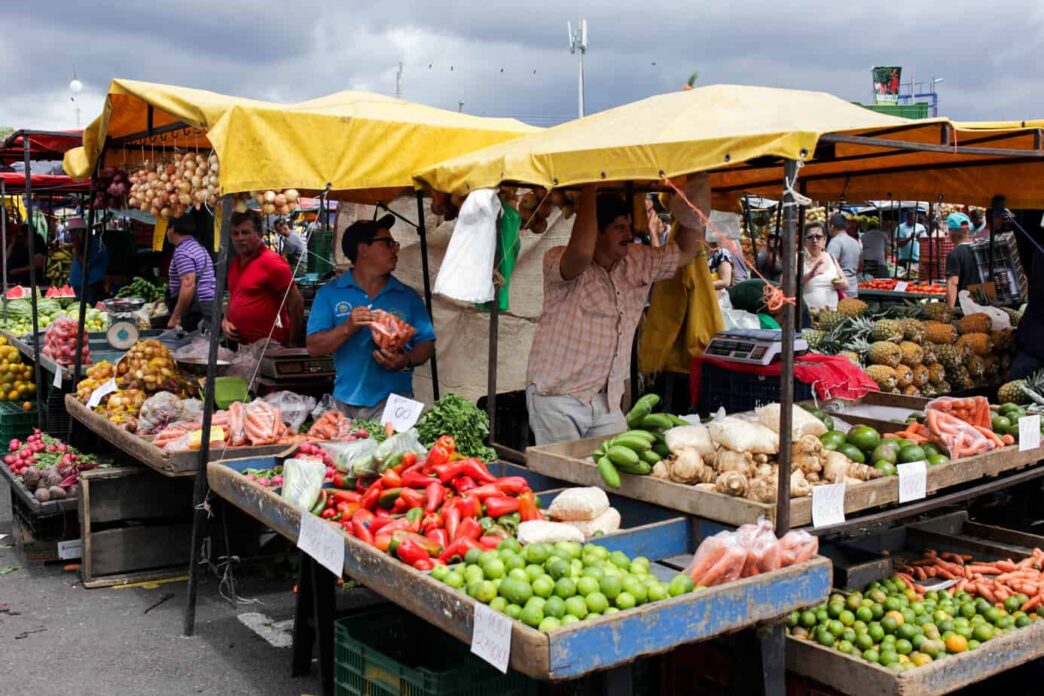
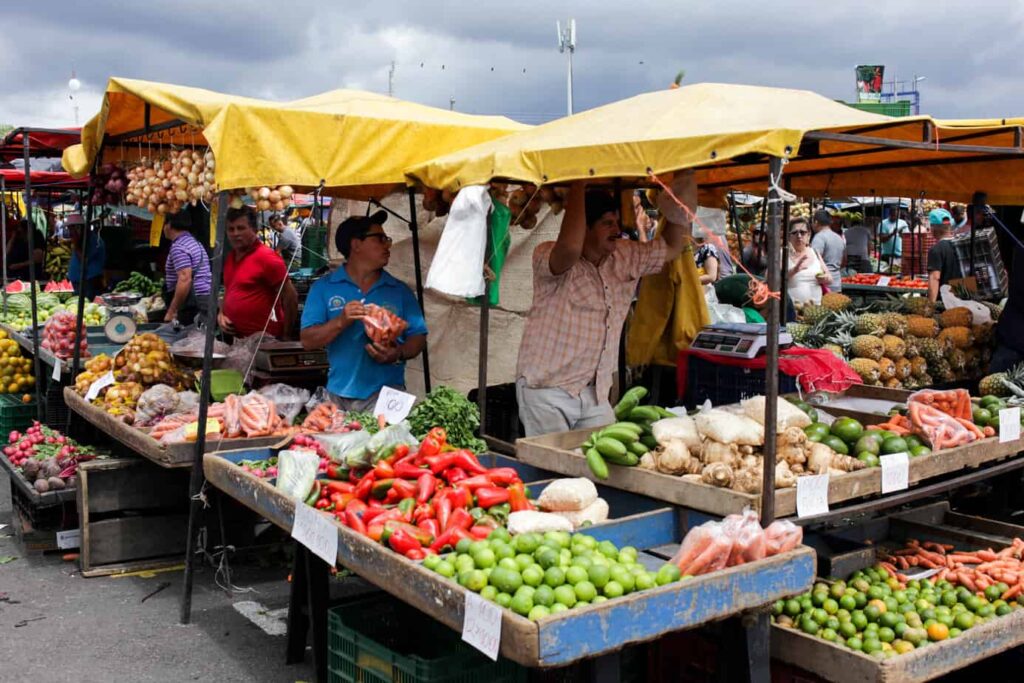
The feria del agricultor, or farmers market, is one of the best ways to get a feel for everyday Costa Rica. These weekly markets are where much of the country buys its food, and they’ve been a fixture in nearly every Tico town for decades. There are no entrance fees, no English menus, and nothing staged for visitors — just local farmers selling what they grew that week. For anyone wanting to taste real Costa Rican produce, it’s hard to do better.
The BasicsWhat a Costa Rica Farmers Market Actually Is
The official name is feria del agricultor — literally, “the farmer’s fair” — and locals just call it la feria. It is a weekly outdoor market where small-scale Costa Rican farmers and food producers set up tarps, tables, and pickup trucks to sell directly to the public. No middlemen, no supermarkets, no markup. Just whatever they harvested or made that week, sold the day they brought it down from the mountains.
The system is regulated and supported by the Costa Rican government through the Consejo Nacional de Producción, which formalized the network in the 1980s to give small farmers a fair selling channel. Today there are roughly 80 official ferias scattered across the country, plus a growing number of organic and artisanal weekend markets that have sprung up around them.
Every town has its day. San José’s ferias run Saturday morning. La Fortuna’s runs Friday. Atenas does Friday. Heredia does Saturday. Some smaller villages only get a feria once a week for four hours — and you can feel the entire town show up for it.
Why It MattersWhy Visit a Farmers Market in Costa Rica
This is one of the few places in Costa Rica where the tourist economy doesn’t really reach. Most stalls aren’t trying to sell you anything you can put in a suitcase — they’re trying to sell beans to the lady who lives two streets over. That’s exactly what makes it worth visiting.
Reason 1
You eat what’s actually in season
Fruit at a feria was picked this week, often this morning. A mango here in May tastes like a different fruit than one shipped to a supermarket in March.
Reason 2
It’s stunningly cheap
A pineapple costs 1,000 colones (about $2). A bag of mandarins, 500. Most travelers leave with two heavy bags for under $10 USD.
Reason 3
You taste fruits you’ve never heard of
Mamón chino, guanábana, jocote, mamey, pejibaye, cas, anona. Most have no English name and most never leave the country.
Reason 4
It’s the real Costa Rica
Kids on bikes, abuelas with shopping carts, farmers in rubber boots, someone selling tamales out of a thermos. It’s the most authentic Tico scene you’ll find.
The Best Farmers Markets to Visit by Area
Almost every town in Costa Rica has a feria, so the question isn’t really where to find one — it’s which one fits where you’re already going. Here are the most rewarding ferias in the country’s most-visited regions.
San José & the Central Valley
Feria Verde de Aranjuez
Saturday · 7am – 12:30pm · Barrio Aranjuez, San José
The country’s most famous organic market and the closest thing Costa Rica has to a Brooklyn-style weekend market. Held at the Polideportivo de Aranjuez since 2010, it focuses on certified organic produce, artisan food, natural cosmetics, and crafts. Live music starts around 10am. Prices are higher than a standard feria — this is more of an event than a grocery run — but the food carts alone are worth the trip.
Feria del Agricultor de Zapote
Saturday · 5am – 1pm · Zapote, San José
One of the largest traditional ferias in the country and the place to see the real working version of a Costa Rican market. Hundreds of producers, mountains of produce, and prices that feel like a different decade. Go early — by 11am the best fruit is gone.
Feria del Agricultor de Heredia
Saturday · 5am – 12pm · Mercado Florense, Heredia
A favorite of locals who say the produce here is the freshest in the Central Valley because so much of it comes from the surrounding hills of Heredia province. Strong dairy and cheese selection, excellent strawberries from the cooler highlands above town.
Feria del Agricultor de Escazú
Saturday · 6am – 12pm · Behind the Escazú Catholic Church
The most expat-friendly feria in the country, set just north of Escazú’s main church. A good first market for travelers because many vendors speak some English, and the produce mix includes the international fruits and vegetables expats tend to ask for.
La Fortuna & Arenal
Feria del Agricultor de La Fortuna
Friday · 6am – 2pm · Behind the Catholic Church, downtown La Fortuna
Small but excellent, and a perfect stop if you’re staying in town with a kitchen. Most of the produce is grown in the lowlands around Arenal — pineapples from San Carlos, papayas, yuca, plantains, and some of the country’s best fresh cheese from local dairy farms. Look for fresh palmito (heart of palm), which is harvested in this region.
Pacific Coast
Feria del Agricultor de Jacó
Friday · 6am – 2:30pm · Next to Clínica Garabito
Jacó’s feria pulls produce from Puriscal (fruits) and Cartago (vegetables, since the hot coast doesn’t grow leafy greens well), so the variety is surprising. A good place to stock up if you’re renting a beach condo.
Feria del Agricultor de Quepos
Saturday · 6am – 1pm · Downtown Quepos, near the marina
The market for Manuel Antonio visitors, about a square block of vendors with a friendly, mixed crowd of locals and travelers. Strong on tropical fruit and fresh seafood from the Pacific. Some English spoken.
Tamarindo Saturday Market
Saturday · 9am – 1pm · Tamarindo, Guanacaste
Smaller and more tourist-oriented than the inland ferias, but the only weekend market in the area. Expect more crafts, smoothies, and prepared food than raw produce. Pricier than the Central Valley.
Guanacaste & the North
Feria del Agricultor de Liberia
Saturday · 5am – 12pm · Across from the Liberia bus terminal
The big feria of Guanacaste province. A great window into the agricultural identity of the dry north — tropical fruits from the lowlands, rice from the plains, and cheeses from the cattle country around Bagaces.
Caribbean Coast
Puerto Viejo Saturday Market
Saturday · 6am – 12pm · Downtown Puerto Viejo de Talamanca
Smaller and more Afro-Caribbean in character, with cacao, coconut products, breadfruit, ackee, and homemade pati (Caribbean turnovers) alongside the usual produce. The atmosphere is unmistakably different — this is a window into the country’s Caribbean culture.
What to Expect at a Costa Rica Feria
Walk in early on a Saturday morning and the first thing you notice is the noise — vendors calling out prices, neighbors shouting greetings across the aisles, the rumble of dolly carts and crates being unloaded. Then comes the color: rows of pineapples stacked into pyramids, hairy red mamón chinos by the kilo, papayas the size of a small dog, hand-lettered cardboard signs taped to crates.
A typical feria has a few clear sections:
- Fruits & vegetables — the largest section by far. Everything from common produce to fruits you’ve never seen before.
- Beans, rice, and grains — usually a few stalls selling Costa Rican black beans, red beans, and rice by the kilo, often cheaper than the supermarket.
- Dairy and cheese — fresh palmito cheese, queso Turrialba (a soft white cheese from the town of the same name), natilla (sour cream), and yogurt in plastic bags.
- Fish & meat — fewer stalls but usually one or two, with fresh fish from the coast (tilapia, corvina) and butcher cuts.
- Tortillas and prepared food — handmade corn tortillas, tamales, empanadas, chorreadas (corn pancakes), and gallo pinto to-go.
- Plants & flowers — ornamental plants, herbs in pots, and cut flowers for almost nothing.
- Snacks and refrescos — fresh fruit juice in plastic bags, coconuts with a straw, agua dulce (hot cane sugar water).
A Note On Atmosphere
Ferias are loud, friendly, slightly chaotic, and entirely cash-based. No one is in a hurry. Vendors will absolutely let you taste before you buy — pointing at a fruit and saying “¿puedo probar?” (“can I try?”) is standard practice. If you’re polite and curious, you’ll get a small piece of half the fruits in the market by the time you leave.
A Guide to Costa Rica’s Tropical Fruits
This is the real reason to go. Costa Rica grows fruits that most travelers have never heard of, and the feria is where you’ll find them at their best, in season, and cheap enough to try them all.
The fruits you’ll see year-round
- Piña (pineapple) — Costa Rica is one of the world’s largest pineapple exporters. Sweet, low-acid, and far better here than abroad.
- Banano & plátano — sweet bananas and starchy plantains, sold by the bunch or the kilo.
- Papaya — huge orange papayas, often sold by the half. Eaten with a squeeze of lime.
- Aguacate (avocado) — usually the smooth-skinned criollo variety, smaller and richer than Hass.
- Maracuyá (passion fruit) — sour, intensely fragrant, used mostly for juice. Scoop the seeds straight out.
- Limón mandarina — Costa Rica’s signature little yellow citrus, used in everything from ceviche to cocktails.
The seasonal ones worth chasing
How to Shop a Costa Rica Farmers Market Like a Local
Get there early
The good stuff is gone by mid-morning. Locals who care about the produce are there by 6:30 or 7am. By 11am you’re picking through what’s left, and most ferias start packing up by noon or 1pm. The first hour is also when the temperature is bearable in coastal markets.
Bring cash, in colones, in small bills
Almost no vendor takes cards. Bring 5,000 and 10,000 colón notes — the equivalent of $10 and $20 — not 20,000s. Vendors won’t always have change for big bills early in the morning. US dollars are sometimes accepted in tourist-heavy ferias like Tamarindo and Jacó but at a poor exchange rate.
Bring your own bags
Costa Rica banned single-use plastic bags at most ferias, and even where they’re still around, vendors will appreciate you not asking. A backpack, a tote, or one of the woven plastic shopping baskets that locals carry works perfectly.
Learn five words of Spanish
You don’t need to be fluent. You need to be able to ask the price, ask if you can taste, and say thank you. The full kit:
Don’t haggle
Prices at a feria del agricultor are already very low and are not negotiable the way they are at, say, a Mexican market. Asking a farmer to lower the price on a $1.50 bag of mandarins is poor form. The exception: buying a large quantity, where you can politely ask if there’s a discount for the whole crate.
Eat breakfast there
Most ferias have a small section of food vendors selling gallo pinto with eggs, empanadas, tamales, and fresh fruit smoothies for two or three dollars. This is the best, cheapest breakfast you’ll have on your trip — and it’s the part most tourists miss.
Why Ferias Matter to Costa Rica
The feria del agricultor isn’t just commerce — it’s the most visible piece of Costa Rica’s small-farm culture. Costa Rica has one of the highest concentrations of small, family-owned farms in Latin America, and the feria system is what keeps many of them economically viable. Without it, the country’s food chain would look like everyone else’s: a handful of supermarket chains buying from large-scale producers and squeezing everyone else out.
The system also reinforces something Ticos take seriously: the idea that food and community are inseparable. A feria isn’t an errand. It’s a Saturday morning ritual. Families go together, neighbors stop and talk, the same vendors greet the same customers by name year after year. For a country that markets itself abroad with the phrase “pura vida,” the feria is one of the few places where you can actually see what that means in everyday practice.
Beyond the Produce
If you spend a Saturday at a feria, you’ll learn more about how Costa Rica actually lives than at almost any organized cultural tour. The slow pace, the willingness to chat, the lack of urgency around closing a sale — these are the same qualities you’ll find on a coffee farm or a beach soda. The feria is just where they’re most concentrated.
Costa Rica Farmers Markets: Common Questions
When do farmers markets happen in Costa Rica?
Most ferias del agricultor run on weekends, with Saturday morning being by far the most common day. La Fortuna, Atenas, and Jacó run on Fridays. A handful of smaller towns hold them midweek. Hours are typically 5am to 1pm, with the best produce gone by 10am.
Do I need to speak Spanish to visit a feria?
No, but five or six words help enormously. Numbers, “¿cuánto?” (how much?), and “gracias” will get you through almost any transaction. In tourist-heavy areas like Tamarindo, Quepos, and Escazú, many vendors speak some English.
Is it safe to eat fruit and prepared food from a Costa Rica farmers market?
Yes. Fresh whole fruit, washed before eating, is completely safe. Prepared food from busy vendors with high turnover is also safe — the empanadas and tamales sold at ferias are made that morning. Use the standard travel rule: if locals are eating it and a line is forming, it’s fine.
How much does a typical feria shop cost?
A bag of mandarins, a pineapple, a papaya, a bunch of bananas, and a kilo of tomatoes will run about 5,000 colones (around $10 USD). Two travelers can stock a vacation rental kitchen for a week of breakfasts and snacks for $20 to $25.
Can I bring fruit back to my hotel or rental?
Absolutely. This is the easiest way to enjoy a feria if you don’t have a kitchen — buy what you can eat fresh that day. Mamón chino, pineapple already cut, mandarins, and bananas are perfect for snacking back at the pool.
What’s the difference between a feria del agricultor and a regular mercado?
A feria del agricultor is an outdoor weekly market where farmers sell directly. A mercado is an indoor or covered permanent market — like Mercado Central in San José — that operates every day and is more shop-based, with butchers, fishmongers, sodas, and dry goods. Both are worth visiting.
Are Costa Rica farmers markets open year-round?
Yes, every weekend, dry season and rainy season alike. Rainy-season markets (May to November) are a little smaller and a little less crowded, but the produce is at its most varied because the rains drive the country’s biggest fruit cycles.
Pura vida — bring cash, get there early, and leave with mango juice on your shirt.