
Most travelers to Guanacaste drive right past it on their way to the beach. That’s their mistake. Santa Rosa is Costa Rica’s oldest national park, the last great stand of tropical dry forest in Central America, the scene of a 14-minute battle that shaped the country’s history, and the nesting ground for one of the planet’s most astonishing wildlife events — all on the same stretch of coastline. Here’s why it’s worth the detour, and how to get the most out of it.
Why It Matters
Four parks in one
Santa Rosa is often described as Costa Rica’s first national park, and while the founding dates vary depending on which decree you count, the point stands: this was where the country’s modern conservation movement began. What sets it apart today is how much it packs into a single protected area. Most Costa Rican parks are about one thing — a volcano, a cloud forest, a stretch of rainforest. Santa Rosa is about four.
One
A rare ecosystem
One of the last significant stretches of tropical dry forest left in Mesoamerica — a habitat that has been nearly wiped out across Central America.
Two
A battlefield
The site of the 1856 Battle of Santa Rosa, a 14-minute clash that is still taught in every Costa Rican classroom.
Three
A turtle sanctuary
Playa Nancite is one of only a handful of places on earth where olive ridley turtles arrive by the tens of thousands in mass nesting events called arribadas.
Four
A surf legend
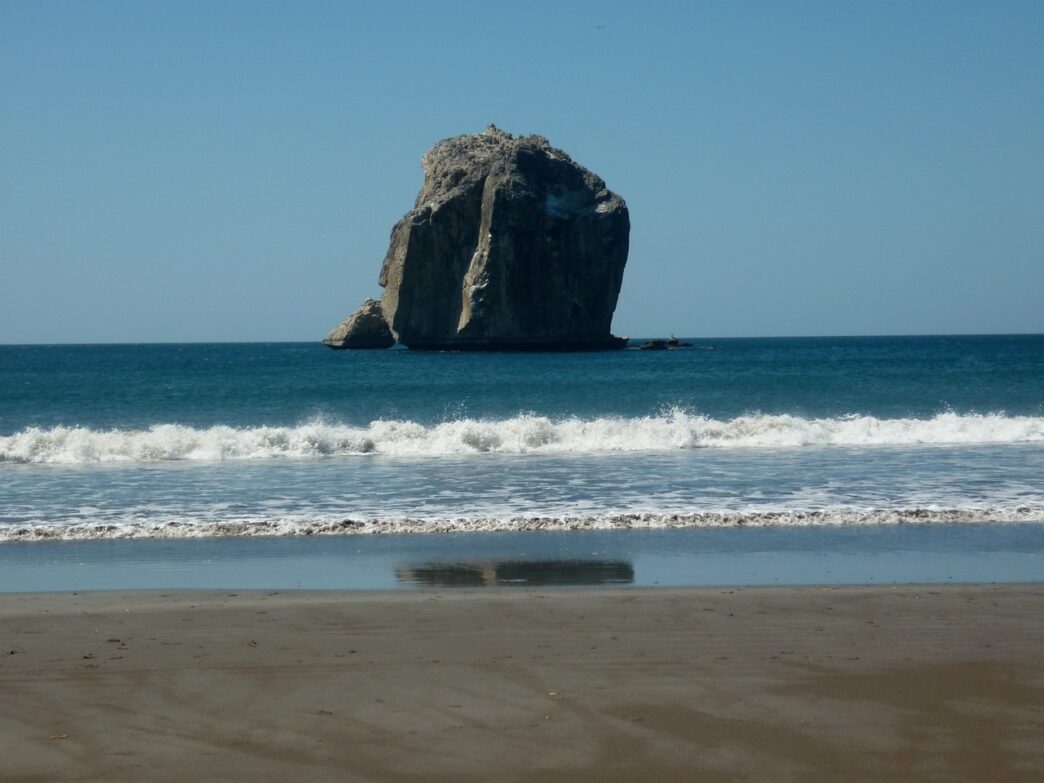
Witch’s Rock — the offshore monolith made famous in Endless Summer II — rises from the sea off Playa Naranjo, drawing surfers from around the world.
Add to that some of the oldest exposed rock in Costa Rica — formations that emerged from the sea more than 85 million years ago — and you have a park that rewards curiosity more than any single activity.
The Dry Forest
The ecosystem you’ve probably never heard of
When people picture a tropical forest, they picture something evergreen, humid, dripping. Tropical dry forest is almost the opposite. For five to six months a year, from roughly December through April, most trees lose their leaves, the ground becomes bone-dry, and the landscape takes on the tawny, parched look of a savanna. Then the rains come, and in a matter of weeks the forest explodes back into green.
This seasonal rhythm is what makes the ecosystem so unusual — and why it has all but vanished from the rest of Central America. Dry forest soils are fertile and easy to clear, and for centuries the region was converted to cattle ranches and cotton fields. By the time Costa Rica began setting protected areas aside, less than two percent of the original tropical dry forest in Mesoamerica was still intact. Santa Rosa protects the largest remaining piece.
What to look for
The guanacaste tree — Costa Rica’s national tree, with its enormous umbrella canopy — dominates open areas. The indio desnudo (naked Indian), named for its peeling, sunburned-looking red bark, lines many of the trails. White-faced capuchin monkeys, howler monkeys, white-tailed deer, coatis, and agoutis are common. With luck and a good guide, so are anteaters, tayras, and even the occasional jaguar track.
The park is a designated UNESCO World Heritage site as part of the broader Guanacaste Conservation Area, which links Santa Rosa’s dry forest to the cloud forest on the slopes of the Orosí and Cacao volcanoes and the rainforest beyond. It’s one of the few places in the world where a single protected corridor stretches from arid coastal plain to continental divide.
The History
The 14-minute battle that made a country
To understand why Santa Rosa was protected in the first place, you have to go back to 1856. A Tennessee-born lawyer named William Walker had seized power in Nicaragua with the backing of pro-slavery interests in the American South. His ambition was larger: he wanted to turn all of Central America into a slave-holding empire and carve a canal from the Caribbean to the Pacific along the San Juan River, decades before Panama.
When word reached San José that Walker’s mercenaries were advancing, President Juan Rafael Mora did something unusual for the time. He raised a civilian army — some nine thousand ordinary Costa Ricans, many of them farmers armed with machetes and old muskets — and marched them north. They met Walker’s forces at the Hacienda Santa Rosa on March 20, 1856. The fight lasted fourteen minutes. The filibusters were routed.
The Ticos pursued Walker’s retreating forces across the border into Nicaragua. Weeks later, at a wooden fort in the town of Rivas, a young drummer boy from Alajuela named Juan Santamaría volunteered to set the fort on fire. He succeeded, flushing the mercenaries out, but was killed in the attempt. He remains Costa Rica’s national hero — the main international airport outside San José bears his name.
La Casona
The colonial-era hacienda where the battle took place — La Casona de Santa Rosa — still stands at the heart of the park, restored after a fire in 2001. Inside, a small museum displays 19th-century weapons, period photographs, and exhibits on the park’s ecology. A short, flat, wheelchair-accessible trail behind La Casona leads to a lookout with views of the Orosí and Cacao volcanoes on a clear day.
The Turtles
Playa Nancite and the arribada
Deep inside the park, reachable only by a rough dirt track or a long hike, Playa Nancite is one of just a few beaches in the world where olive ridley turtles come ashore in mass nesting events known as arribadas. When conditions are right — most often during the rainy season, between July and December — tens of thousands of females arrive on a single beach within a few days, digging nests, laying eggs, and disappearing back into the surf. In peak years, the beach has hosted more than a hundred thousand turtles in a single arribada.
Nancite is a protected research beach, so access is restricted: you need a permit from park authorities, and visits are usually arranged through the ranger station at the main entrance. It’s not a casual stop. But for serious wildlife travelers, it is one of the most profound natural events on the Pacific coast of the Americas.
For a more accessible olive ridley experience, Ostional Wildlife Refuge — a few hours south of Santa Rosa — also hosts arribadas and is easier to visit with a licensed guide.
The Surf
Witch’s Rock and Ollie’s Point
If you’ve seen The Endless Summer II, you’ve seen Santa Rosa. The offshore monolith off Playa Naranjo — Roca Bruja, or Witch’s Rock — produces one of the most photographed right-hand beach breaks in the world. A few kilometers north, Ollie’s Point (named, as legend has it, after Oliver North, whose Contra-era activities in the area gave the break its nickname) offers a long, peeling right that surfers travel across continents to ride.
Both breaks sit inside the park, which means access is regulated. Most visiting surfers reach them by boat from Playas del Coco or Tamarindo rather than attempting the brutal 13-kilometer 4×4 track down to Playa Naranjo from the main entrance. Boat tours are the sensible way to do it unless you are specifically there to camp at the beach.
What to Do
The trails and sectors worth your time
Santa Rosa is divided into two sectors. Most visitors only ever see the first.
Santa Rosa (the main sector)
This is the cultural and historical heart of the park. From the entrance, a paved road runs seven kilometers to the administrative area, where you’ll find La Casona, the museum, a campground, and the trailheads. Several short, well-marked trails loop out from the administrative area — the Indio Desnudo trail is the easiest and most rewarding for first-time visitors, a flat 800-meter loop through classic dry forest with interpretive signs identifying native tree species. Longer trails lead deeper into the forest and down toward the coast for those with more time and a 4×4.
Murciélago (the remote sector)
Reached by a separate entrance further north on the highway, the Murciélago sector protects the wild Santa Elena Peninsula — a landscape of secondary forest, former cattle country, and some of the most isolated beaches in Costa Rica. Playa Blanca, with its white sand and turquoise water, is the reward for the drive in. Most of the year it’s empty. Bring everything you need; there are almost no services. A high-clearance 4×4 is non-negotiable.
A realistic expectation
Santa Rosa is not Manuel Antonio. Wildlife is more dispersed, the drives are longer, the trails are hotter, and the vibe is quieter. Travelers expecting a steady parade of animals at close range will leave disappointed. Travelers who come for history, ecology, empty beaches, and a genuine sense of wild Costa Rica will leave glad they skipped the crowd.
Plan Your Visit
Practical essentials
When to go
The dry season, roughly December through April, is the easiest time for visiting. Skies are clear, trails are firm, and wildlife concentrates around the few remaining water sources — which makes animals easier to spot. The trade-off is heat: Guanacaste regularly pushes past 35°C in March and April. The rainy season (May to November) transforms the forest into a lush green canvas and brings turtle nesting to the coast, but back roads can become impassable and the Murciélago sector is often inaccessible.
Getting there
The main entrance is on Route 1, the Pan-American Highway, about 36 kilometers north of Liberia and easily reached from Liberia International Airport (LIR) in under an hour. From the Guanacaste beach towns — Playas del Coco, Hermosa, Tamarindo — it’s a straightforward 60–90 minute drive. From San José, plan on around five hours by road.
What to bring
- Sun protection — broad-brim hat, SPF 50+, sunglasses. The dry forest offers less shade than you’d expect.
- Plenty of water — there are limited facilities once you leave the administrative area. Two liters per person is a minimum.
- Insect repellent — especially at dusk and during the rainy season.
- Closed-toe shoes with grip. Snakes, including fer-de-lance, are present.
- Cash for the entrance fee. Card payment is not always reliable at the gate.
- A 4×4 if you plan to reach the coast or visit Murciélago. Standard rental sedans will not make it.
Where to stay
Most visitors base in Liberia or the Playas del Coco / Hermosa area and visit Santa Rosa as a day trip. Inside the park itself, basic camping is available at the administrative area with cold showers, toilets, and a handful of picnic shelters — a memorable, stripped-back option for travelers who want to hear howler monkeys at dawn. Reservations should be made in advance through SINAC, the national parks service.
Guided versus independent
La Casona and the main trails are easy to explore on your own. For the coast, Playa Nancite, or the Murciélago sector — and for any chance of serious wildlife spotting — a guide is strongly recommended. Local tour operators in Liberia, Playas del Coco, and La Cruz run day trips that handle transport, entrance fees, and naturalist guiding in one package.
Why Bother
The case for the detour
Santa Rosa is not the easiest park in Costa Rica to visit, and it is not the flashiest. It doesn’t offer hanging bridges or zip lines. The trails require more imagination than the cloud forests of Monteverde. The wildlife won’t crowd the path the way it does at Manuel Antonio.
What it offers instead is rarer. It is the place where a civilian army defended a young country’s independence in fourteen minutes. It is the last great stand of an ecosystem that has nearly disappeared from the continent. It is the quiet, honest, hot, and windswept version of Guanacaste that existed long before the resorts arrived — and that will, with luck, still be here long after.
If you’re driving past on the Pan-American Highway with even a few hours to spare, turn left at the gate. You’ll understand Costa Rica a little better by the time you leave.