
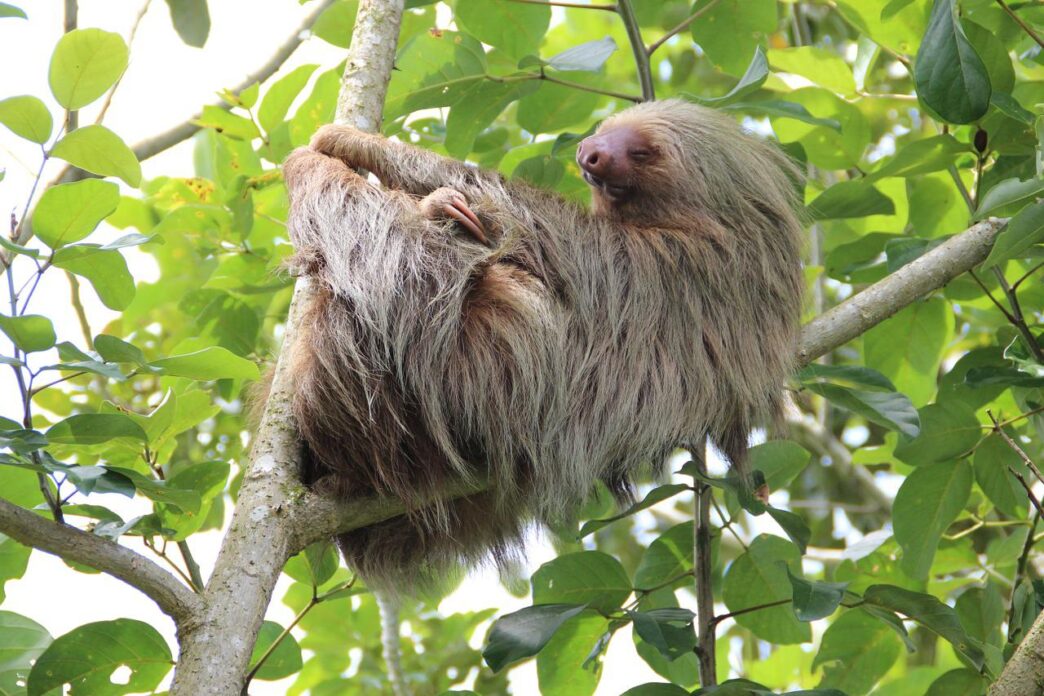
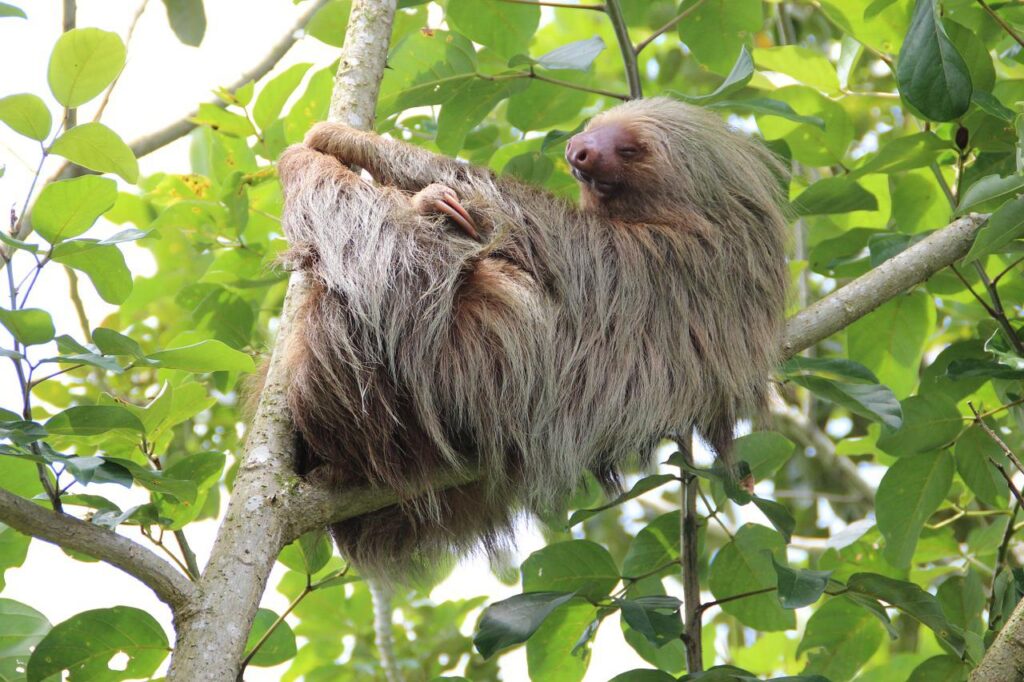
Few wildlife moments stop a child mid-sentence like the first sloth in the wild — a slow, deliberate shape unfolding from the green, claws hooked over a branch, in absolutely no hurry to be anywhere. Costa Rica is one of the best places on earth to give your kids that moment, and the good news is you don’t need to trek deep into remote rainforest to find it.
Sloths turn up in national parks, on flat shaded trails, and in Caribbean beach towns where they lounge in trees beside the road, the hotel pool and the path to the sand. The trick is picking the right spot for your family, going at the right time of day, and knowing when a guide is worth the money. Here’s where to look — and how to actually see one.
The Best Places to See Sloths With Kids
Several destinations give families a genuinely strong chance of a sighting. They range from a compact, beach-backed national park on the Pacific to laid-back Caribbean towns where sloths feel like neighbours. Start with the one that fits your trip.
Manuel Antonio National Park
On the Central Pacific coast, Manuel Antonio is the easiest and most family-friendly place in the country to see a sloth. The park is small, the trails are well maintained and level, and the mix of rainforest and beach turns the visit into a full day rather than a quick nature walk. Sloths are regularly spotted in the canopy along the trails, especially around the guarumo (cecropia) trees they love to feed in.
Go early. The park opens at 7 a.m. and runs to 4 p.m., Wednesday through Monday — it’s closed on Tuesdays. The cooler morning hours are better for wildlife and far easier on kids before the heat and crowds build. Tickets must be bought in advance online through SINAC; they sell out in peak season and are not available at the gate. Entry runs about $18 for adults and $5 for children aged 2–12, with under-2s free.
A guide isn’t required, but for families it’s strongly recommended. Sloths are experts at vanishing into the leaves even when they’re hanging directly overhead, and a certified guide with a spotting scope can turn a vague brown blob into a clear view of a sloth’s face, claws and slow-motion stretch. That single moment is usually what the kids remember.
Near the entrance, unofficial vendors sometimes pose as park staff to sell “tickets” or tours. Tickets are only sold through the official SINAC website — buy yours before you arrive and ignore anyone selling park entry on the street.
Puerto Viejo & the Caribbean Coast
Puerto Viejo, on the southern Caribbean coast, offers a completely different kind of sloth experience. The corridor running from Cahuita through Puerto Viejo and Playa Chiquita toward Manzanillo is one of the best areas in the country for casual, unplanned sightings. Families spot sloths along the beach roads, near hotels, beside restaurants and while pedalling rented bikes through town.
That’s exactly what makes it special for kids. There’s something they never forget about finding a sloth by chance on the way to the beach — it feels less like a scheduled tour and more like a real discovery they made themselves.
Cahuita National Park
Just up the coast, Cahuita National Park is another strong option, and arguably the gentlest national park walk in the country for young children. Its coastal trail is mostly flat, shaded and easy underfoot. Sloths share the forest here with monkeys, raccoons, iguanas, basilisk lizards and a long list of birds, so even a slow stroll tends to turn up something.
Because the trail hugs the shoreline, you can pair a wildlife walk with beach time and let tired legs recover in the sand — an easy formula for a half-day with kids.
Jaguar Rescue Center
Near Puerto Viejo in Playa Chiquita, the Jaguar Rescue Center is worth a stop for families who want to understand sloths beyond a quick sighting. The center rehabilitates injured, orphaned and displaced wildlife, sloths included, and runs public tours.
It isn’t the same as spotting one in the wild, but it helps children grasp the very real threats these animals face — road accidents, dog attacks and electrocution on power lines — and why we keep our distance in the forest.
Tortuguero National Park
On the remote northern Caribbean coast, Tortuguero has one big advantage for families with little ones: boats. Instead of long rainforest hikes, you sit in a covered boat while guides scan the trees and riverbanks lining the canals. Sloths are part of the wildlife mix here, and the boat format is far kinder to short legs and short attention spans.
La Fortuna & Arenal
The La Fortuna and Arenal area is excellent for sloths, though you shouldn’t expect to find them in every corner of Arenal Volcano National Park. Most sightings happen in the lower-elevation forest around town, on private reserves and dedicated sloth trails.
For families, the standout is the Bogarín Trail, a flat, shaded loop right in downtown La Fortuna that you can often walk to from the central park. It’s a regenerated rainforest reserve with a resident population of sloths, so a guided walk here comes about as close to a guaranteed sighting as wild animals allow — guides typically find several over a relaxed couple of hours. The nearby Sloth Territory trail is a similar option. Either way, a guide is worth it: the two-fingered sloth is mostly nocturnal, and trained eyes spot the sleeping ones you’d walk straight past.
Costa Rica’s Two Sloth Species
Costa Rica is home to two native sloths, and knowing the difference helps set your family’s expectations for what you’ll actually see — and when. They’re commonly called “toed,” though many biologists now prefer “fingered,” since both species have three toes and the real difference is the claws on their front limbs.
Three-fingered sloth
Brown-throated, Bradypus variegatus
- Active during daylight hours
- Easier for kids to spot awake
- Often higher in the canopy
- The classic “smiling” sloth face
Two-fingered sloth
Hoffmann’s, Choloepus hoffmanni
- Mostly nocturnal
- Usually seen asleep in the day
- Larger, with a piggier snout
- A guide’s eyes really help here
Tips for Spotting Sloths With Kids
The advice that actually moves the needle is simple: go early, bring binoculars and ask around. Sloths spend most of their lives motionless and high in the trees, so small wins make a big difference for young eyes.
A pair of lightweight binoculars can transform a frustrating “where is it?” into a real face-to-face for a child. In towns like Puerto Viejo and La Fortuna, hotel staff, guides and neighbours often know exactly which tree a sloth was lounging in that morning — so just ask.
Remind children never to touch, feed or crowd a sloth. The best sighting is one where the animal keeps doing exactly what it was doing before people showed up. Getting too close stresses them and, with some operators, encourages unethical handling — keep your distance and let them be wild.
For the simplest family outing, Manuel Antonio is hard to beat. For something slower and more spontaneous, the Caribbean coast around Puerto Viejo and Cahuita may be even better. And if you want a near-sure thing within walking distance of dinner, the Bogarín Trail in La Fortuna is tough to top. Whichever you choose, that first wild sloth is usually the memory the kids carry home long after the tan fades.
Planning the rest of your wildlife days? Our Costa Rica wildlife guide covers the monkeys, birds and reptiles you’ll meet alongside the sloths, and the Marino Ballena National Park guide is a great Pacific add-on if you’re basing near Manuel Antonio.
Frequently Asked Questions
Where is the easiest place to see a sloth in Costa Rica with kids?
Manuel Antonio National Park is the easiest for most families. The trails are short and level, the wildlife is concentrated, and a beach at the end keeps the day fun for children. Hiring a guide with a spotting scope dramatically improves your odds of a clear view.
What time of day are sloths easiest to see?
Early morning, right when parks open around 7 a.m. It’s cooler, less crowded and easier on kids. Three-fingered sloths are active in daylight, while two-fingered sloths are mostly nocturnal and usually seen sleeping during the day.
Do we need a guide to see sloths?
Not strictly, but it’s the single best thing you can do to actually see one well. Sloths blend into the canopy and barely move, so a trained guide with a scope finds animals you would walk right past — and lets kids see the face, claws and slow movements up close.
Can you see sloths in Puerto Viejo without a tour?
Often, yes. The southern Caribbean corridor from Cahuita to Manzanillo is known for casual sightings along beach roads, near hotels and from a bike. It’s one of the most relaxed places to come across a sloth by chance.
Is it safe and ethical to get close to a sloth?
Keep your distance and never touch, feed or hand-hold a sloth, no matter what an operator offers. Handling stresses these animals badly. The goal is a sighting where the sloth keeps doing exactly what it was doing — observe quietly and move on.
How many sloth species live in Costa Rica?
Two: the brown-throated three-fingered sloth (active by day) and Hoffmann’s two-fingered sloth (mostly nocturnal). Spotting both on one trip is very doable, especially on guided walks.
Pura Vida — go slow, look up, and let the kids find the first one.