
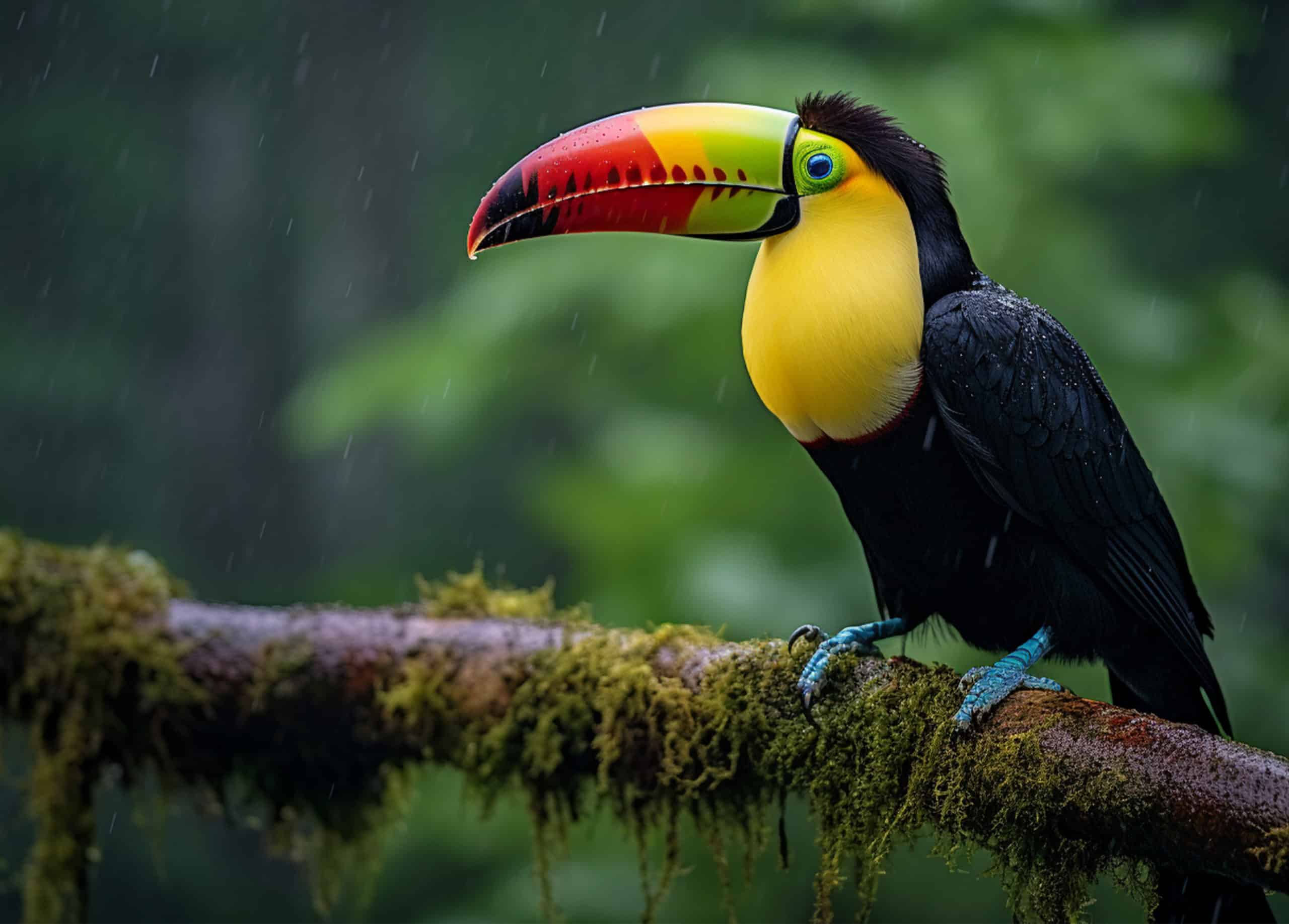
Most travelers land in Costa Rica with three birds in mind: a toucan, a macaw and a quetzal. All three are here, but none of them is the bird you’ll see first. That one is plain brown, sings from the hotel garden at dawn and happens to be the national bird.
The birds of Costa Rica you’re most likely to see are the clay-colored thrush, great kiskadee, blue-gray tanager, great-tailed grackle, black vulture and rufous-tailed hummingbird, which turn up in gardens and towns across the country. Scarlet macaws, toucans and quetzals take a specific region and an early start. This article covers 25 birds, sorted by how easy they are to find, with the places to look for each.
At a glance
Birds of Costa Rica at a glance
Costa Rica’s official bird list runs to about 950 species, including more than 50 hummingbirds, six toucans, six motmots and two macaws. You won’t see most of them on a normal vacation. These are the ones worth knowing, and what it takes to see each.
| Bird | Where to look | Your odds |
|---|---|---|
| Clay-colored thrush | Gardens and towns nationwide | Near certain |
| Great kiskadee | Wires, fences and gardens nationwide | Near certain |
| Scarlet macaw | Carara, the Central Pacific coast, the Osa Peninsula | High in the right place |
| Keel-billed toucan | Arenal, Sarapiquí, the Caribbean side | Good at dawn |
| Yellow-throated toucan | Manuel Antonio, the Osa Peninsula, Caribbean lowlands | Good at dawn |
| Montezuma oropendola | Arenal, Sarapiquí, Tortuguero | High |
| Turquoise-browed motmot | Guanacaste | High |
| Resplendent quetzal | San Gerardo de Dota, Monteverde | Fair, better with a guide |
| Great green macaw | Sarapiquí, Maquenque, Manzanillo | Low; plan for it |
| Jabiru | Palo Verde, Caño Negro | Low; best in dry season |
Everyday birds
Common birds you’ll see almost anywhere
These six show up at hotel gardens, town plazas and roadside sodas (small local restaurants) from the Central Valley to both coasts. Learn them on day one and everything else stands out.
- Clay-colored thrush (yigüirro). Plain brown, about the size of an American robin, with a yellowish bill. It’s the national bird, picked for its song at the start of the rainy season and not for its looks. Read more in our article on Costa Rica’s national bird.
- Great kiskadee. Bright yellow belly, black-and-white striped head and a loud call that sounds like its name. It perches on wires and fence posts. Several other flycatchers wear the same colors, so don’t worry about telling them apart at first.
- Blue-gray tanager. Pale powder blue all over, usually in pairs, and a regular at fruit feeders. Ticos call it the viuda, or widow.
- Great-tailed grackle (zanate). Glossy black, long-tailed and noisy. It runs town plazas, parking lots and beach restaurants.
- Black vulture (zopilote). The dark birds circling over every town and highway. The turkey vulture, with a red head, often soars alongside.
- Rufous-tailed hummingbird. The most common hummingbird in gardens: green with a rusty tail and a reddish bill. Our article on how to photograph hummingbirds in Costa Rica has camera settings and tips.
The big names
The famous birds: macaws, toucans and the quetzal
These are the birds on the postcards. Each lives in a particular part of the country, so where you stay decides which ones you get.
- Scarlet macaw (lapa roja). Red, yellow and blue, and loud. Carara National Park, about 1.5 hours from San José, is the easiest place to see one. The Osa Peninsula has the most birds.
- Great green macaw (lapa verde). Green with a red forehead, critically endangered and found on the Caribbean side, around Sarapiquí and Maquenque. Plan for this one. Our article on macaws in Costa Rica covers both species.
- Keel-billed toucan. The one with the rainbow bill. Look on the Caribbean side and in the northern lowlands, including Arenal and Sarapiquí.
- Yellow-throated toucan. The country’s largest toucan, at about 24 inches, with a two-tone bill. It’s the big toucan of Manuel Antonio and the Osa Peninsula, and it also lives in Caribbean-side forests. See our article on Costa Rica’s six toucans.
- Resplendent quetzal. Emerald green with a red belly; males trail tail streamers up to about two feet long. It lives only in highland cloud forest. San Gerardo de Dota and Monteverde are the places to go, and February to April, during nesting, is the easiest time. Our article on the quetzal in Costa Rica has the details.
Easy color
Colorful birds of gardens and forest edges
You don’t need a deep-forest hike for color. These birds like gardens, farm edges and lodge feeders.
- Scarlet-rumped tanager. The male is velvet black with a red patch on the lower back that flashes when he flies. Common in the Caribbean lowlands and on the southern Pacific side.
- Lesson’s motmot. Green with a black mask, a blue-ringed crown and a long tail ending in two racket tips, which it swings side to side like a pendulum. Common in Central Valley gardens and coffee farms. Older books call it the blue-crowned motmot.
- Turquoise-browed motmot. Smaller, with a turquoise brow and longer bare tail shafts. It’s a dry-forest bird, common in Guanacaste, where it sits on fences and roadside wires. It’s also the national bird of Nicaragua and El Salvador.
- Montezuma oropendola. Crow-sized and chestnut brown with a yellow tail. Colonies weave hanging nests two to six feet long in a single tall tree, and the male’s gurgling call is hard to forget. Look around Arenal, Sarapiquí and Tortuguero.
- Crimson-fronted parakeet. Green with a red forehead, flying in screeching flocks. It’s the common parrot of San José and other Central Valley towns.
- White-throated magpie-jay. Blue and white with a curled crest and a long tail. Noisy, bold flocks patrol hotel grounds and beach towns in Guanacaste.
- Violet sabrewing. A large, deep-violet hummingbird of the cloud forest and a regular at feeders around Monteverde.
By the water
Birds of rivers, wetlands and the coast
A boat trip is the easiest birding there is. The birds are big, they sit in the open and the boat guide does the spotting. The Tárcoles River, the Tortuguero canals, Caño Negro and Palo Verde are the classic trips. Our article on Costa Rica’s wetlands explains how they differ.
- Brown pelican. Flies in lines low over the surf on both coasts and plunge-dives for fish.
- Magnificent frigatebird. Long, angular wings and a deeply forked tail, hanging over the coast without flapping. Males have a red throat pouch.
- Bare-throated tiger-heron. A large, finely barred heron that stands still on riverbanks. Common along the Tortuguero canals and the Tárcoles River.
- Roseate spoonbill. Pink, with a flat, spoon-shaped bill. Look in mangroves, river mouths and the wetlands of Palo Verde and Caño Negro.
- Jabiru. A white stork nearly five feet tall, with a black head and a red band at the base of the neck. It’s rare. The dry season at Palo Verde or Caño Negro, when the water shrinks and birds gather, gives you the best chance.
Worth the work
Forest birds that take some effort
Two more for travelers who get hooked.
- Great curassow. Turkey-sized. The male is black with a curly crest and a yellow knob on the bill; females are brown to rufous. Hunting has removed it from much of Central America, but it’s still fairly easy to see in protected forests here, such as La Selva, Arenal and Corcovado.
- Three-wattled bellbird. Heard far more often than seen. The male’s loud, metallic bonk carries across the Monteverde cloud forest during the breeding months, roughly March to July.
By region
Which birds you’ll see in each region
Match your itinerary to this table and you’ll know what to listen for before you unpack.
| Region | Birds to expect |
|---|---|
| San José and the Central Valley | Clay-colored thrush, crimson-fronted parakeet, Lesson’s motmot, rufous-tailed hummingbird, blue-gray tanager |
| Guanacaste beaches | White-throated magpie-jay, turquoise-browed motmot, great-tailed grackle, brown pelican, magnificent frigatebird |
| Arenal and La Fortuna | Keel-billed toucan, Montezuma oropendola, scarlet-rumped tanager, great curassow |
| Monteverde | Resplendent quetzal, violet sabrewing, three-wattled bellbird |
| Central Pacific (Carara, Jacó, Manuel Antonio) | Scarlet macaw, yellow-throated toucan, scarlet-rumped tanager, roseate spoonbill |
| Osa Peninsula | Scarlet macaw, yellow-throated toucan, great curassow |
| Caribbean side (Tortuguero, Sarapiquí, Puerto Viejo) | Keel-billed toucan, great green macaw, Montezuma oropendola, bare-throated tiger-heron |
For the places themselves, see our articles on San José, Tamarindo, Monteverde and Manuel Antonio National Park.
Field tips
How to see more birds in Costa Rica
- Get up early. The first two hours after sunrise are the busiest. By late morning in the lowland heat, activity drops off sharply.
- Stand near a fruiting tree or a feeder. Toucans, tanagers and oropendolas come back to the same food again and again. Many lodges put out fruit. Leave the feeding to them, and don’t hand-feed wild birds.
- Take one boat tour. It’s the least effort for the most birds, and it works for kids and for anyone who can’t hike.
- Hire a local guide for one morning. A guide with a spotting scope finds birds you’d walk past, and it’s the surest way to a quetzal.
- Use the Merlin Bird ID app. It’s free. Download the Costa Rica pack before you travel so it works without a signal.
- Bring binoculars. A compact pair is enough. See our binocular picks for Costa Rica.
If birds are the main reason for your trip, our article on bird watching in Costa Rica covers the best birding areas and seasons, and the month-by-month wildlife calendar shows what else is active when you visit.
Common mistakes to avoid
- Expecting a quetzal at the beach. It lives only in the cool highlands. Add a night in Monteverde or San Gerardo de Dota if you want one.
- Looking only at eye level. Toucans, macaws and oropendolas sit in the treetops.
- Paying for a photo with a macaw or toucan on your arm. Those are captive birds, whatever the sign says.
- Sleeping in. A 5:30 a.m. start beats any amount of gear.
Common questions
Birds of Costa Rica: frequently asked questions
What are the most common birds in Costa Rica?
The clay-colored thrush, great kiskadee, blue-gray tanager, great-tailed grackle, black vulture and rufous-tailed hummingbird are the birds most visitors see first. They live in gardens, towns and open country across most of the country.
What is the national bird of Costa Rica?
The clay-colored thrush, known locally as the yigüirro. It’s a plain brown songbird, valued for its song at the start of the rainy season.
How many bird species are there in Costa Rica?
About 950 species are on Costa Rica’s official bird list, including more than 50 hummingbirds, six toucans and two macaws.
Where can I see toucans in Costa Rica?
Look for the keel-billed toucan on the Caribbean side and in the northern lowlands, including Arenal and Sarapiquí. On the central and southern Pacific coast, including Manuel Antonio and the Osa Peninsula, the large toucan is the yellow-throated. Early morning is best.
What is the red, blue and yellow parrot in Costa Rica?
That’s the scarlet macaw, called the lapa roja. Carara National Park and the Osa Peninsula on the Pacific side are the best places to see it.
What is the best app for identifying birds in Costa Rica?
Merlin Bird ID, a free app from the Cornell Lab of Ornithology. Download the Costa Rica pack before your trip so you can use it offline.
The short version
Learn the six everyday birds first, then pick your region for the famous ones: Carara or the Osa Peninsula for scarlet macaws, Arenal or the Caribbean side for the keel-billed toucan, and the highlands for a quetzal.Be outside at first light, look up and listen. In Costa Rica you usually hear the bird before you see it.