
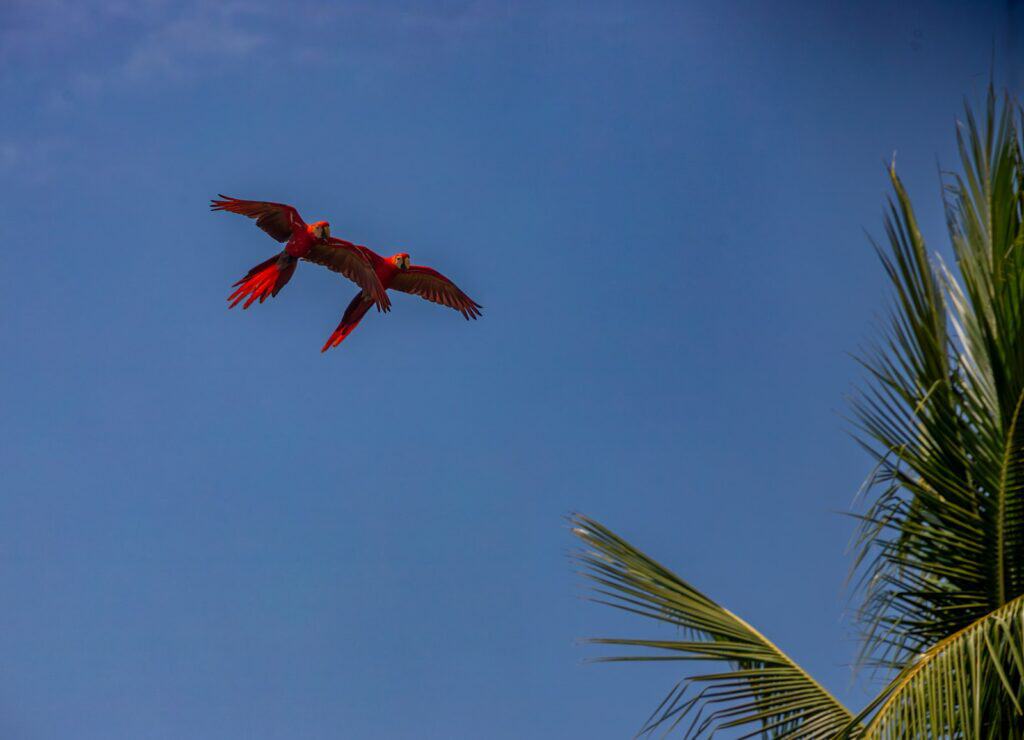
Most visitors picture one macaw: red, yellow and blue, screeching across a beach. Costa Rica has two, and they live on opposite sides of the country. Which one you see depends almost entirely on which coast you visit.
The best places to see macaws in Costa Rica are Carara National Park and the Osa Peninsula for scarlet macaws on the Pacific side, and the Caribbean lowlands for the critically endangered great green macaw. Go at dawn or late afternoon, when pairs fly between roosts and feeding trees, and listen first. You’ll almost always hear a macaw before you see it.
- 2 speciesScarlet and great green, Costa Rica’s largest parrots
- Two coastsScarlet on the Pacific, great green on the Caribbean side
- Dawn & duskWhen pairs are flying and calling, and easiest to spot
Know the difference
Scarlet macaw vs. great green macaw
Ticos call both birds lapas: the scarlet is the lapa roja and the great green is the lapa verde. You’ll hear those names from guides and on park signs.
| Scarlet macaw | Great green macaw | |
|---|---|---|
| Looks | Red body, yellow and blue wings, long red tail | Green body, red forehead, blue flight feathers |
| Coast | Pacific | Caribbean |
| Best bets | Carara National Park, Osa Peninsula | Sarapiquí and Maquenque, Manzanillo near Puerto Viejo |
| Odds | High in the right places | Lower; plan for it |
| Status | Not globally threatened; recovering in protected areas | Critically endangered |
Pacific coast
Where to see scarlet macaws
- Carara National Park. The easiest reliable sighting in the country, about 1.5 hours from San José and 15 to 20 minutes from Jacó. Walk the short, flat trails early, and watch the sky around the Tárcoles River bridge, where pairs often cross the coastal highway at the start and end of the day. Our Carara National Park article covers tickets and trails.
- Osa Peninsula. The country’s other stronghold, and the place to see macaws in numbers. Around Puerto Jiménez, Drake Bay and the edges of Corcovado, they feed noisily in the beach almond trees along the shore. See our Corcovado National Park article.
- Punta Islita and the southern Nicoya Peninsula. The Ara Project, now part of the Macaw Recovery Network, has bred and released scarlet macaws here, and the released birds now breed in the wild.
- Manuel Antonio and the Central Pacific. Sightings happen, but don’t build a day around them. If macaws are the goal, make the trip to Carara.
Caribbean side
Where to see great green macaws
The great green is the harder bird, and the more rewarding one. It depends on the almendro, or mountain almond, a giant lowland tree it uses for nest holes and food. When the forest lost its almendros, the macaws went with them, and the species is now listed as critically endangered.
- Sarapiquí and Maquenque. The northern Caribbean lowlands, toward the Nicaraguan border, hold the country’s remaining wild nesting pairs. Birding lodges here know which trees the macaws are feeding in that month, so ask when you book.
- Manzanillo, near Puerto Viejo. Ara Manzanillo, the Caribbean release site run by the Ara Project’s Costa Rican association, has returned great greens to the southern Caribbean coast. Visits are by reservation through its website. Pair it with our Puerto Viejo article.
Field tips
How to actually see macaws in Costa Rica
- Go in the first two hours of daylight. Macaws leave their roosts early to feed, then fly back in the late afternoon. Midday is quiet.
- Listen before you look. The call is a loud, harsh squawk that carries a long way. Follow it.
- Look for pairs. Macaws mate for life and fly side by side, wingtips almost touching, often with a family group trailing behind.
- Watch the feeding trees. Scarlets work beach almond trees along the Osa coast; great greens feed in almendros inland.
- Bring binoculars. Perched macaws can sit high in the canopy for long stretches. Our binocular picks help, and our camera gear article covers lenses for wildlife.
- Hire a guide for great greens. Guides track where the birds are feeding week to week. Our bird watching article covers where to find good ones.
Both species live here year-round, so any month works. The dry months, December to April, make early-morning hikes easier on the Pacific side. Our month-by-month wildlife calendar shows what else you can see on the same trip, and our list of Costa Rica animals you can actually see covers the rest of the cast.
Conservation
Why the great green macaw is in trouble
Only about 500 to 1,000 great green macaws remain in the wild across their whole range, and the bird was listed as critically endangered in 2020. The main threats are the same ones that hit scarlet macaws decades ago: logging of nesting trees and chicks taken from nests for the pet trade.
Costa Rica’s constitutional court banned cutting the almendro tree in 2008, which protects the macaws’ nesting trees. Breeding and release programs have added birds on both coasts. Seeing a wild pair fly over is still a matter of luck and timing, which is part of why it stays with people.
Common questions
Macaws in Costa Rica, answered
Where is the best place to see macaws in Costa Rica?
For scarlet macaws, Carara National Park is the easiest, about 1.5 hours from San José, and the Osa Peninsula has the most birds. For great green macaws, try the Sarapiquí and Maquenque area or the Ara Manzanillo release site near Puerto Viejo.
Are there macaws in Manuel Antonio?
Occasionally, but sightings aren’t reliable. Carara National Park, about 1.5 hours north, is the better bet if macaws are a priority.
What’s the difference between a scarlet macaw and a great green macaw?
The scarlet macaw is red with yellow and blue wings and lives on the Pacific side. The great green macaw is mostly green with a red forehead, lives on the Caribbean side and is critically endangered.
Is the scarlet macaw Costa Rica’s national bird?
No. Costa Rica’s national bird is the clay-colored thrush, or yigüirro, a plain brown songbird that sings at the start of the rainy season.
When is the best time to see macaws in Costa Rica?
Any month, since both species live here year-round. Time of day matters more: go early in the morning or in the late afternoon, when macaws fly between their roosts and feeding trees.
The short version
For a red macaw, go to Carara or the Osa Peninsula and be there at first light. For a green one, head to the Caribbean lowlands with a guide and some patience.Either way, keep your distance, skip the captive-bird photo stops and listen for the squawk. It’s usually the first sign that a pair is about to fly over.
Browse by topic
Not sure where to start? Pick the part of the trip you are working on.