
Poás is the volcano where you can stand on the rim of an active crater and look down at a steaming, milky-blue acid lake, about an hour from Costa Rica’s main airport. It is also the park most likely to be closed, half-hidden by fog or sold out on the day you want to go. This article is for travelers planning a Poás volcano visit from San José or the Central Valley: how to check if it is open, how SINAC’s online-only tickets work, what the current safety rules mean for you, and how to time your slot so you actually see the crater.
Poás Volcano National Park at a glance
- Status
- Open with safety limits at the time of writing. It closes without much warning when the volcano acts up. Check before you book.
- Entrance fee
- $15 plus 13% tax for foreign adults ($16.95). $5 plus tax ($5.65) for children 2 to 12. Under 2 free. Residents and nationals pay about ₡1,000.
- Tickets
- Online only through SINAC, for a specific date and entry time. No sales at the gate.
- Hours
- 8 a.m. to 4 p.m., last entry 2 p.m.
- Crater time
- Up to 20 minutes at the viewpoint, helmet on.
- From SJO airport
- About 1 hour; 1 to 1.5 hours from San José.
- Summit elevation
- 2,708 meters (8,885 feet). Expect 50s Fahrenheit and wind.
Quick answer
Is Poás volcano open?
At the time of writing, yes, with restrictions. After an energetic eruption at 2:36 a.m. on Aug. 27, 2026, the park stayed open, but SINAC, the national park service, cut daily capacity roughly in half, from 2,052 to 1,064 visitors. It also capped the crater viewpoint at 56 people at a time and made helmets mandatory on the two trails that remain open. Those rules have no end date. They stay until the volcano calms down, and access can tighten again if activity rises.
Poás has a long record of sudden closures, so treat any “open” statement, including this one, as a snapshot. Here is the recent pattern:
- 2017 to 2018: closed for well over a year after a series of strong eruptions, then reopened with helmets and timed visits.
- Late March 2025: closed during a strong eruptive phase. It reopened on July 30, 2025.
- January 2026: closed for about a week, Jan. 21 to 29, because a bridge on Route 120, the main access road, needed emergency repairs. The volcano itself was not the problem.
- Late August 2026: stayed open after the eruption, with the capacity and helmet rules described above.
Before you book
How to check Poás status the day you go
Check the week you plan to visit and again the night before.
- Try to book on SINAC. If the park is closed, its dates will not be available. It is the fastest practical test.
- Check OVSICORI’s volcano bulletins. OVSICORI is Costa Rica’s volcano and earthquake observatory. A rising alert level is your early warning. Our article on volcano alert levels explains what green, yellow, orange and red mean for visitors.
- Scan local news. Spanish-language outlets report closures within hours. Search “Volcán Poás cierre.”
- Watch your email. If SINAC closes the park on short notice, it contacts ticket holders to rebook. Weather is not a reason for a refund.
Costs and logistics
Poás volcano tickets: price, time slots and how to buy
You cannot buy a Poás ticket at the gate. Every visitor needs an advance ticket from SINAC’s online system for a set date and entry time. Rangers check your confirmation against your passport, so names cannot be changed after purchase.
- Price: $16.95 for foreign adults 13 and older and $5.65 for children 2 to 12, tax included. Kids under 2 enter free. Costa Rican citizens and legal residents pay a colón rate of about ₡1,000 per adult.
- What you need: a SINAC account, each visitor’s full name and passport number, and a credit or debit card that supports online verification.
- Limit: up to 10 tickets per transaction.
- Entry slots: staggered from 8 a.m. to 2 p.m. Arrive at the gate for the time printed on your ticket.
- Parking: paid separately at the park, by card.
- Free day: admission is free on Aug. 24, National Parks Day, but you still need a reserved ticket.
With daily capacity halved, weekends, Costa Rican holidays and the December-to-April high season sell out first. Book at least a few days ahead, and earlier for a holiday week. For a step-by-step walkthrough of the booking site, including the account-creation quirks, see our article on buying park tickets on SINAC.
On the summit
What you see at the Poás crater, and for how long
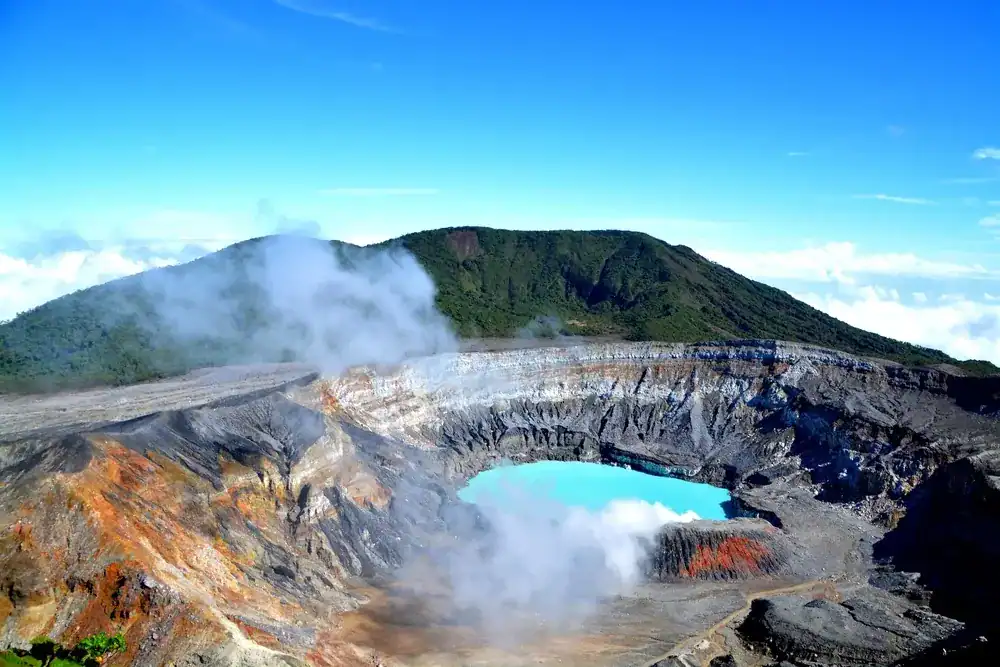
From the parking area, a paved path climbs gently for about 10 minutes to the main viewpoint. There is no hiking to speak of. The crater is roughly 1.3 to 1.5 kilometers across and about 300 meters deep. At the bottom sits Laguna Caliente, one of the most acidic lakes on Earth, with a pH close to zero. Its color shifts from turquoise to gray depending on activity, and in active phases the water can shrink or vanish, leaving fumaroles (steam vents) hissing on the crater floor.
You get up to 20 minutes at the viewpoint, with a helmet on, before staff rotate the next group in. Most visitors spend about 45 minutes to an hour in the park in total. The only other trail open under current rules is Sombrilla de Pobre, a short forest loop named for a large-leafed plant whose leaves can shelter a person from the rain. Helmets are required there too.
Laguna Botos, the cold, green lake in an older crater, has been closed for long stretches since 2017 and was not on the list of open trails after the August 2026 changes. Do not plan your visit around it.
Getting there
Poás volcano tour from San José vs driving yourself
Poás sits north of Alajuela, above the town of Poasito. The road is paved the whole way but steep and winding near the top, often in cloud, and lined with strawberry stands and dairy farms. Allow about an hour from SJO airport and 1 to 1.5 hours from central San José, depending on traffic. From Liberia’s airport, it is roughly four hours each way, which makes a day trip impractical. From La Fortuna, it is about 2.5 hours via Vara Blanca.
| Rental car | Guided tour | |
|---|---|---|
| Cost | Ticket, parking and gas | Higher; most full-day tours include the ticket |
| Timing | You pick the 8 a.m. slot | Tied to the group schedule, often later |
| Booking | You buy SINAC tickets yourself | Operator handles it |
| Best for | Travelers who want first light at the crater | First-timers who would rather not drive mountain roads |
Our recommendation: drive yourself if you are comfortable on narrow mountain roads, because you control the arrival time and the early slot matters more than anything else. Read our article on driving in Costa Rica before you go. If you book a tour, confirm in writing that the park ticket is included, and ask which entry time the operator holds. Public bus service to the summit is limited and changes often, so it is a poor bet for most visitors.
Poás pairs easily with other stops in the area. Many tours add La Paz Waterfall Gardens or a coffee farm, and our list of day tours from San José shows how families combine them.
Timing
Best time to visit Poás volcano
The drier months, roughly December through April, give you the best odds of a clear crater, though clouds can still sweep in by 10 a.m. From May through November, the green season (what Ticos call the rainy months), afternoons are often wet and foggy, so the first slot of the day is even more important. Weekdays are calmer than weekends, when Costa Rican families drive up from the Central Valley. For month-by-month patterns, see our best time to visit by region article.
Who it suits
Who should go, and who should skip Poás
-
Go if
You are based in San José, Alajuela or Heredia, or you are flying in or out of SJO and have a free morning.You want to see an active crater with almost no hiking. The paved path suits most ages.
-
Skip it if
You are staying in Guanacaste, where four hours each way is too much for 20 minutes at a rim.You want a real volcano hike. Arenal Volcano National Park offers lava-field trails, and our roundup of Costa Rica’s best volcanoes compares the alternatives.
Before you go
What to bring and common mistakes
- Showing up without a ticket: the gate does not sell them, and you will be turned away.
- Forgetting your passport: the name and number must match your reservation.
- Dressing for the beach: the summit is often around 50 to 54 degrees Fahrenheit (10 to 12 Celsius), windy and damp. Bring a fleece and a rain jacket.
- Booking an afternoon slot in the rainy months: you may see nothing but white.
- Expecting to stay long: plan for about an hour in the park, not a full day.
- Flying a drone: drones need a permit in Costa Rica’s national parks.
FAQ
Poás volcano FAQ
Is Poás volcano open right now?
At the time of writing it is open with limits: 1,064 visitors a day, 56 people at the viewpoint at once and mandatory helmets. It can close at short notice, so check SINAC’s booking system and OVSICORI before you go.
How much are Poás volcano tickets?
Foreign adults pay $16.95 and children 2 to 12 pay $5.65, tax included. Children under 2 enter free. Costa Rican citizens and residents pay a small colón fee.
Can I buy Poás tickets at the entrance?
No. Tickets are sold only online through SINAC for a specific date and entry time. You show your confirmation and passport at the gate.
How long can you stay at the Poás crater?
Up to 20 minutes at the main viewpoint. Most visits, including the walk from the parking lot, take 45 minutes to an hour.
What time is best to see the Poás crater?
The first entry slot at 8 a.m. Clouds often fill the crater by mid-morning, and there are no refunds for poor visibility.
How far is Poás volcano from San José?
Allow 1 to 1.5 hours by car from central San José and about an hour from SJO airport. The last stretch is paved but steep and winding.
Is it safe to visit Poás volcano?
Authorities consider it safe enough to stay open under current rules, which is why helmets, time limits and visitor caps are in place. Follow ranger instructions and leave if you have trouble breathing.
Plan the rest of your Central Valley trip
Poás fits neatly into a first or last day near the airport. Our San José article covers where to base yourself, and the airport guide helps you decide between SJO and Liberia.Want a photo worth keeping from those 20 minutes? Read our tips on photographing a volcano in Costa Rica.